

Acute compartment syndrome: a time-sensitive surgical emergency
Emergency physicians are among those best trained to identify patients at risk of losing a limb to compartment syndrome. How confident are you that you can:
use the Stryker needle successfully?
name the four compartments of the lower leg?
calculate the delta pressure?
name all of the 5 Ps?
Acute compartment syndrome (ACS) results from excessive pressure within a fascial compartment. Untreated, it leads to ischemia, infarction, and possibly Volkmann's contracture.
Top things the EM provider needs to know
Most common in patients under 35 years. Males are 10 times more likely to be affected.
Most common in the lower leg (anterior and deep posterior compartments), then the forearm (volar compartment).
Time-sensitive: know the 5 Ps of increasing compartment pressure.
Delta pressure = diastolic pressure − compartment pressure.
Elevate the at-risk extremity, remove any dressings, and treat pain.
Have a low threshold to check pressures with the Stryker device.
Rhabdomyolysis is present in more than 40% of traumatic ACS.
The key to diagnosis is clinical suspicion and repeated exams.
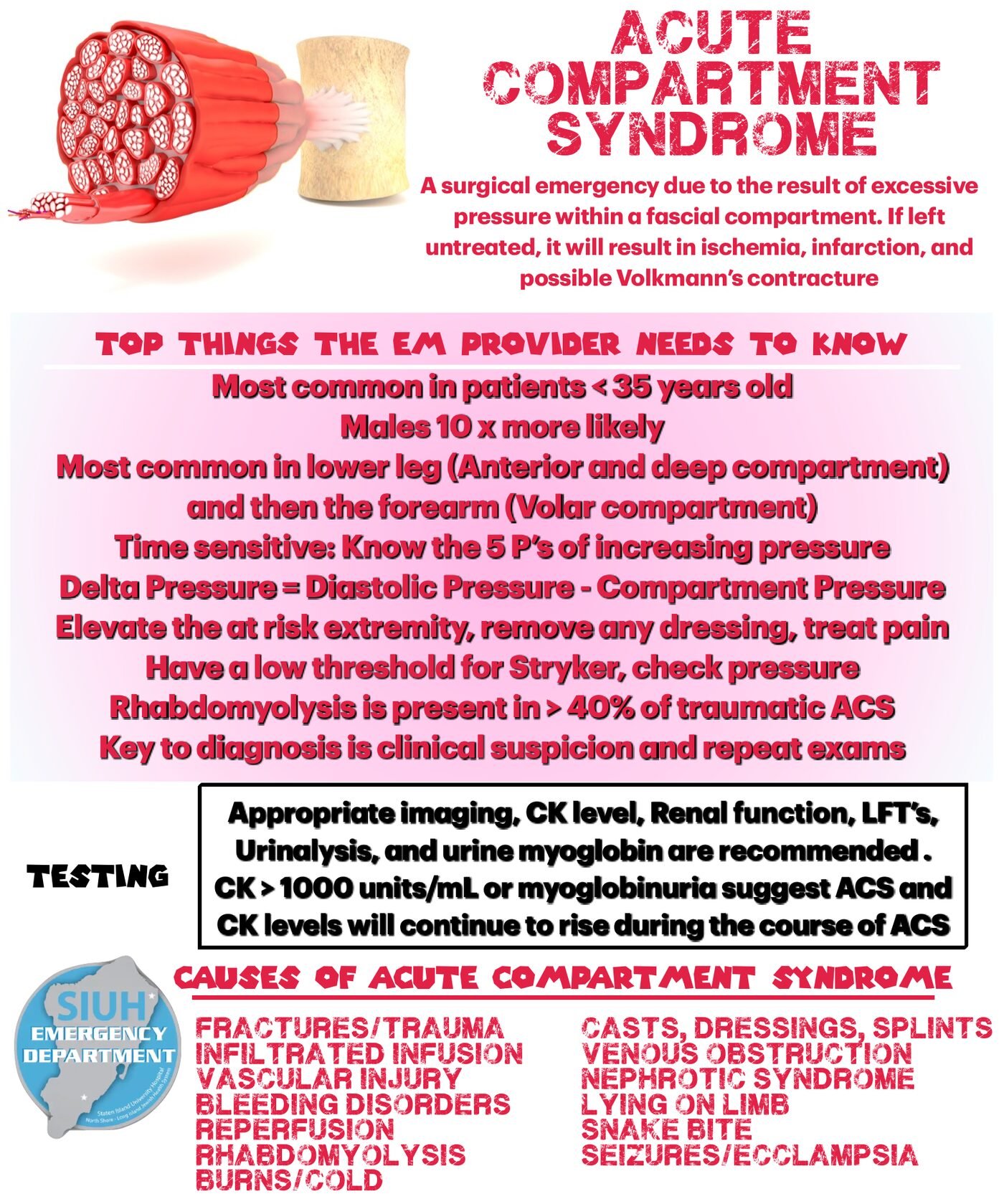
Causes
Fractures and trauma
Casts, dressings, and splints
Infiltrated infusion
Vascular injury and reperfusion
Venous obstruction
Bleeding disorders
Rhabdomyolysis
Burns and cold injury
Nephrotic syndrome
Lying on a limb
Snake bite
Seizures/eclampsia
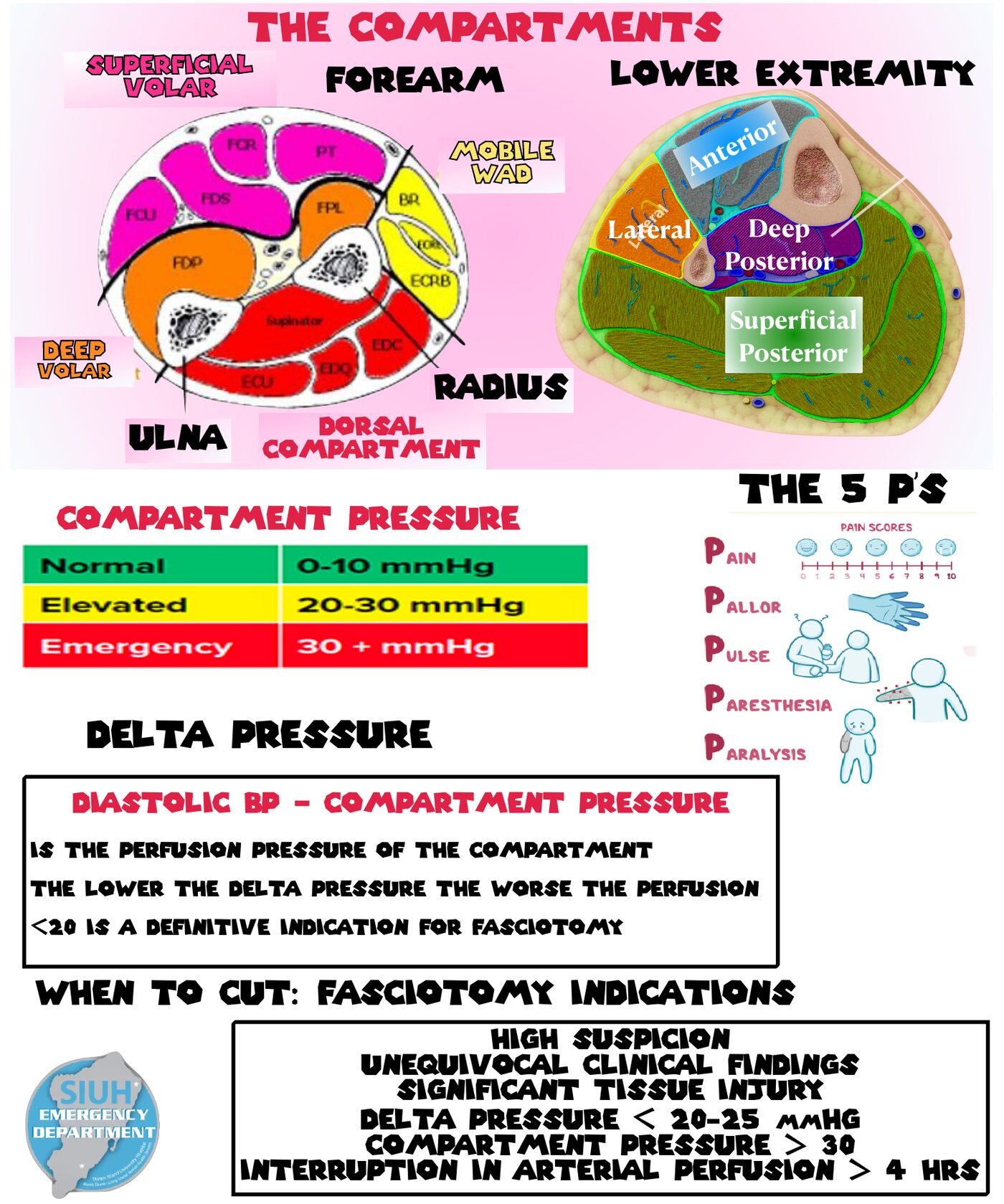
The compartments
Lower leg: anterior, lateral, superficial posterior, deep posterior.
Forearm: superficial volar, deep volar, dorsal, and the mobile wad.
Testing
Appropriate imaging, CK, renal function, LFTs, urinalysis, and urine myoglobin are recommended.
CK > 1,000 U/L or myoglobinuria suggests ACS. CK continues to rise as ACS progresses.
Compartment pressure and delta pressure
Delta pressure (diastolic BP − compartment pressure) is the perfusion pressure of the compartment. The lower the delta pressure, the worse the perfusion.
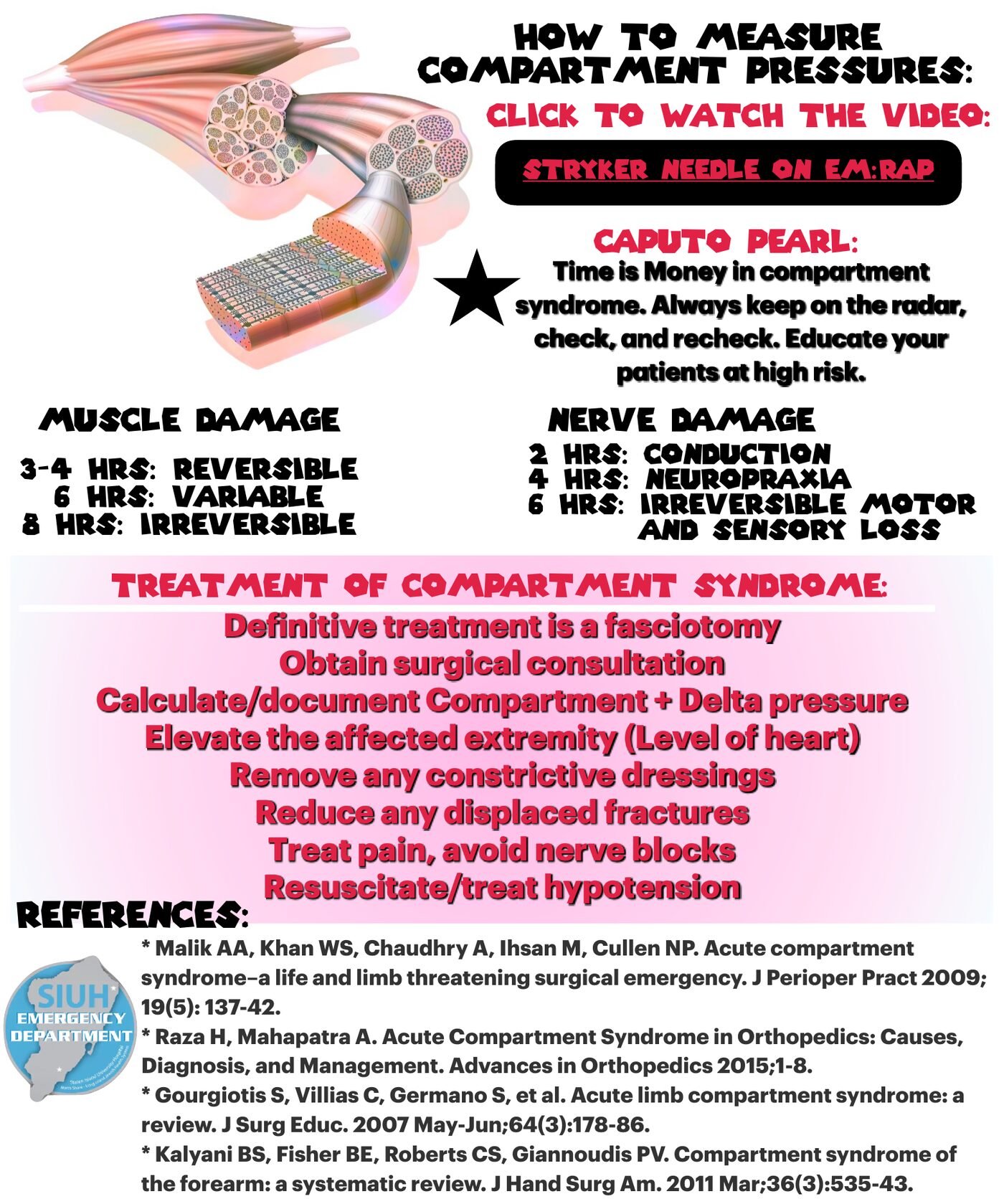
See the figures, the linked PDF, and the EM:RAP Stryker needle video for how to measure compartment pressure.
Fasciotomy indications
High clinical suspicion with unequivocal clinical findings
Significant tissue injury
Delta pressure < 20–25 mmHg (< 20 mmHg is a definitive indication)
Compartment pressure > 30 mmHg
Interruption of arterial perfusion for > 4 hours
The clock is ticking
| Duration of ischemia | Muscle | Nerve |
|---|---|---|
| 2 hours | Conduction changes | |
| 3–4 hours | Reversible | |
| 4 hours | Neurapraxia | |
| 6 hours | Variable | Irreversible motor and sensory loss |
| 8 hours | Irreversible |
ED management
Definitive treatment is fasciotomy. Obtain surgical consultation early.
Calculate and document the compartment pressure and delta pressure.
Elevate the affected extremity to the level of the heart.
Remove any constrictive dressings, splints, or casts.
Reduce displaced fractures.
Treat pain, but avoid nerve blocks.
Resuscitate and treat hypotension, which lowers the delta pressure.
Clinical pearls
Caputo pearl: Time is muscle in compartment syndrome. Keep it on your radar, check, and recheck. Educate high-risk patients.
Pain out of proportion, and pain with passive stretch, are early findings. Pulselessness is a late finding.
Hypotension worsens compartment perfusion. Treat the blood pressure as well as the limb.
References
Malik AA, Khan WS, Chaudhry A, Ihsan M, Cullen NP. Acute compartment syndrome: a life and limb threatening surgical emergency. J Perioper Pract. 2009;19(5):137–142.
Raza H, Mahapatra A. Acute compartment syndrome in orthopedics: causes, diagnosis, and management. Adv Orthop. 2015:1–8.
Gourgiotis S, Villias C, Germano S, et al. Acute limb compartment syndrome: a review. J Surg Educ. 2007;64(3):178–186.
Kalyani BS, Fisher BE, Roberts CS, Giannoudis PV. Compartment syndrome of the forearm: a systematic review. J Hand Surg Am. 2011;36(3):535–543.
