

Two dermatology cases, one common denominator
Two recent pediatric ED cases with different diagnoses and different plans, but herpes simplex virus (HSV) was the common denominator in both.
Case 1: An 8-month-old with a worsening rash
An 8-month-old, fully immunized infant presents with the rash pictured below. The pediatrician started mupirocin and cephalexin a couple of days before the ED visit. The child has remained afebrile, but the rash is not improving. Dermatology saw the child and sent them to the ED for further evaluation. Per the mother, the child usually has eczema in the antecubital folds.
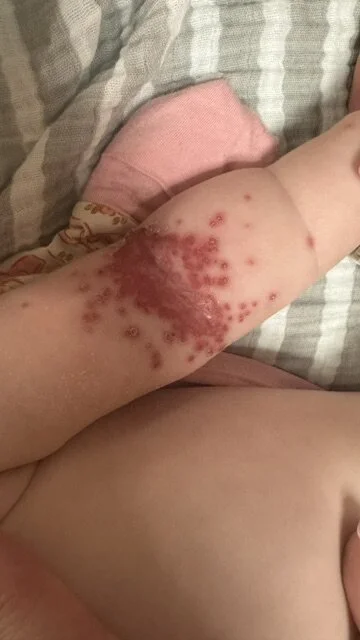
The exam, as pictured, is suggestive of eczema herpeticum.
Plan
Swab the skin for HSV-1 and HSV-2 PCR.
Swab the skin for routine bacterial culture.
Start acyclovir.
Follow-up: viral culture was positive for HSV-1.
Eczema herpeticum
HSV infection superimposed on atopic dermatitis, usually HSV-1 and sometimes HSV-2.
This is a dermatologic emergency. Treat promptly with acyclovir.
Oral acyclovir for mild to moderate disease.
IV acyclovir for a more extensive rash or an ill-appearing child.
Consider bacterial culture and antibiotics, because secondary Staphylococcus or Streptococcus infection can occur.
Case 2: A 12-day-old with a facial rash and a maternal cold sore
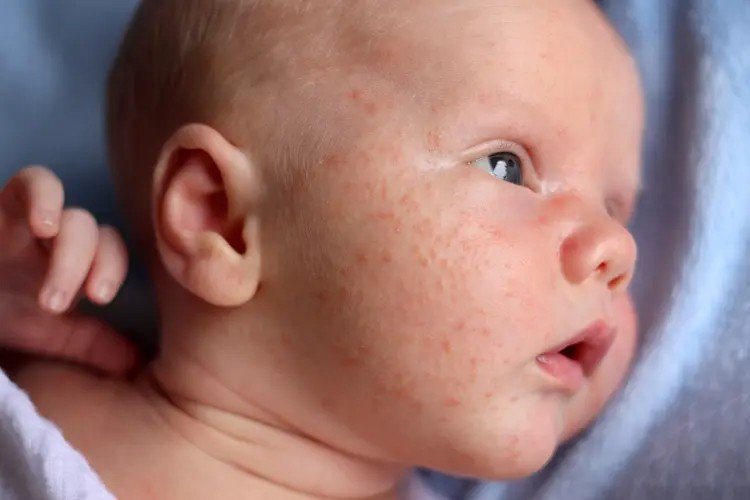
A 12-day-old boy is brought in by his parents for a rash on his face. He is afebrile, feeding well with a strong suck, and has normal urine output; he received the usual newborn vaccines. His mother is very worried: over the past day she developed a cold sore on her lower lip, and now the baby has a rash. She took valacyclovir at the onset of symptoms but is concerned she may have given the baby herpes.
The newborn looks great, but you can clearly see a cold sore on the mother's lower lip. What do you do?
Plan
Labs: CBC, CMP, blood culture, blood HSV PCR.
Skin swab of the lesions for HSV-1 and HSV-2 PCR.
Skin swab of the lesions for bacterial culture.
Start IV acyclovir.
Admit.
Outcome
The rash was classic neonatal acne, a normal and benign rash. The baby looked great and, apart from the history, had a completely normal exam. However, neonatal herpes can be fatal and must be taken seriously. Pending culture results, the infant was admitted on acyclovir for observation. Once the PCR returned negative, acyclovir was stopped and the infant was discharged.
Neonatal herpes
Usually acquired during delivery from exposure to maternal genital HSV.
HSV-2 is classically associated with neonatal disease, but HSV-1 is increasingly common.
Transmission risk is highest when the mother has a new primary genital HSV infection near the time of delivery, because maternal antibodies have not yet developed.
Most cases present in the first 4 weeks of life, but disease can present up to 6 weeks.
SEM disease (vesicular lesions of the Skin, Eyes, and Mouth) may appear around days 10–12 and can progress to CNS or disseminated disease.
ALT/AST will likely be elevated in disseminated disease.
Board question
An 18-day-old term neonate presents to the ED after a 1-minute generalized tonic-clonic seizure. Vital signs: rectal temperature 35 °C, HR 150/min, RR 28/min, BP 84/45 mmHg, SpO₂ 100% on room air. Capillary refill is 3 seconds. Rapid IV isotonic fluids are given after labs are drawn, along with amoxicillin and gentamicin. Which additional medication is indicated to cover the likely infectious cause?
A. Acyclovir
B. Meropenem
C. Vancomycin
D. Ceftriaxone
Answer: A. Acyclovir. This neonate presents with hypothermia and a new-onset seizure. Although there are many possible causes, CNS infection should be high on the differential at this age. Antibiotics should target the most common bacterial pathogens (Streptococcus pneumoniae, group B Streptococcus, Staphylococcus aureus, E. coli, and Listeria). The seizure should also alert the clinician to possible HSV CNS infection and prompt administration of acyclovir.
Clinical pearls
Eczema plus a rash that is not improving on antibiotics: think eczema herpeticum and start acyclovir.
A neonate with possible HSV exposure gets a full HSV work-up and IV acyclovir, even when the baby looks well.
Neonatal HSV can present up to 6 weeks of life. Seizure or hypothermia in a neonate should prompt acyclovir along with antibiotics.
Further reading
Pediatric EM Morsels: Eczema herpeticum
Pediatric EM Morsels: Neonatal HSV
