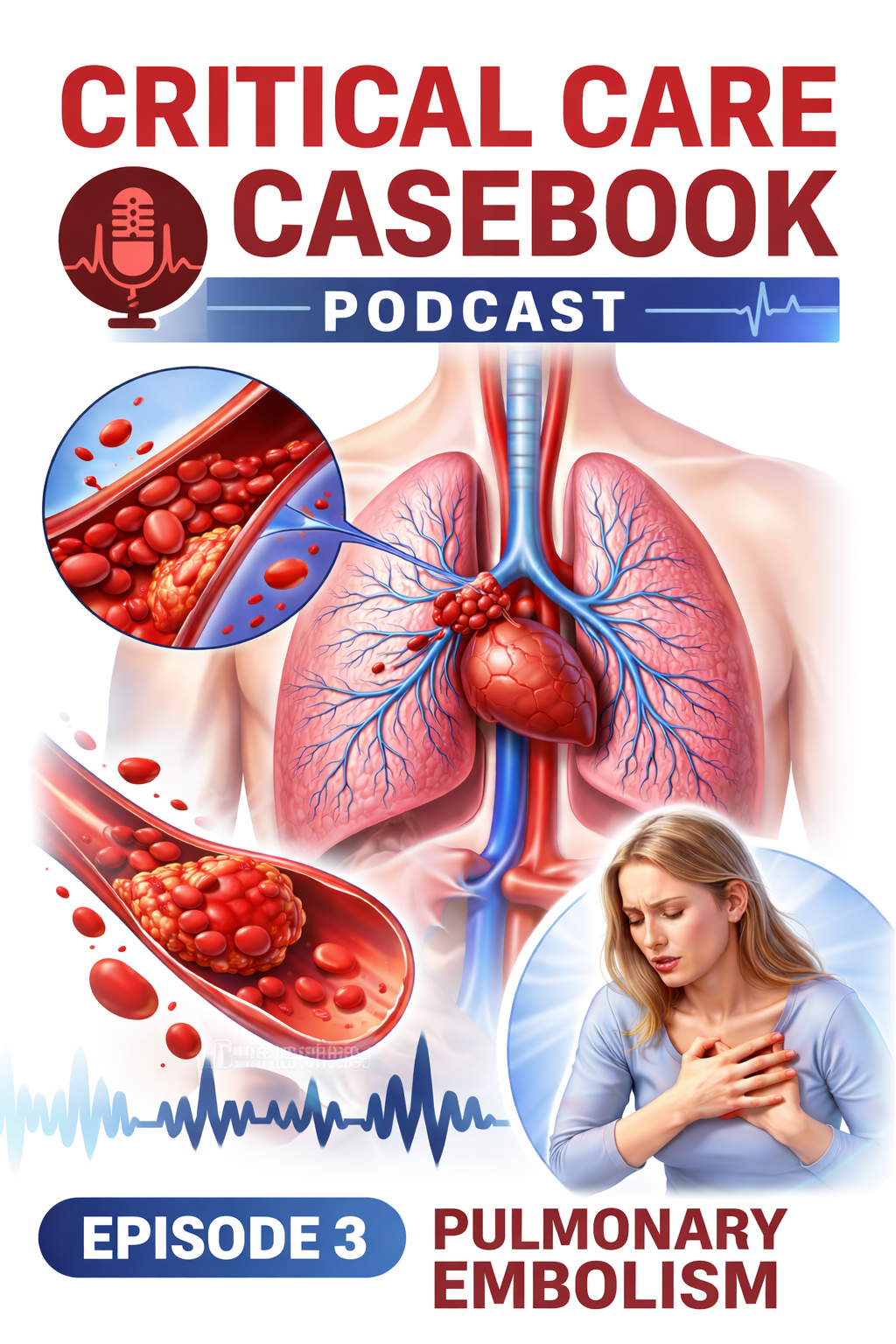

Critical Care Casebook Episode 3: Pulmonary Embolism
In this episode of the Critical Care Casebook, hosts Brendan and Dr. Eli Azrak are joined by Dr. Boris Khodorkovsky to discuss the management of a critical pulmonary embolism case. They navigate through the diagnosis and treatment of a 74-year-old female with a hip replacement suffering from pronounced respiratory distress linked to bilateral main pulmonary artery emboli with right heart strain. The discussion provides an in-depth look at the initial approach, vital diagnostic steps, and the use of various treatments including Heparin, thrombolytics, and pressors. The conversation highlights the challenges faced in different emergency settings, particularly in resource-limited environments, and the crucial steps in patient transfer and resuscitation. The episode concludes with key takeaways for emergency medicine professionals on the management of PEs, emphasizing early anticoagulation, the strategic use of imaging and ultrasound, and the importance of maintaining a high index of suspicion for PE in patients with unexplained shortness of breath.
00:00 Introduction to the Critical Care Casebook
00:27 Meet the Experts: Dr. Eli Azrak and Dr. Boris Khodorkovsky
01:04 Dr. K's Unique Clinical Setting
02:09 Case Introduction: Pulmonary Embolism
02:33 Initial Diagnostic Approach
05:03 Managing the Pulmonary Embolism
09:28 Patient's Critical Turn and Immediate Actions
13:45 Resuscitation Efforts and Final Outcome
19:32 Key Takeaways and Final Thoughts
Shortness of breath + clear lungs = think PE, anemia, tamponade
Use POCUS early for patients with SOB—lungs and heart
High-probability PE → skip D-dimer
Start heparin early when PE is likely and in unstable massive PE, consider lytics early
Resuscitate in the ED, not during transport
Don't worsen RV failure--avoid phenylephrine, excessive fluids, and intubation when possible
Favor epinephrine, norepinephrine, and vasopressin for hypotensive patients with PE
Transfer decisions should be made early, but executed after stabilization
Know your hospital’s resources—and plan accordingly. ECMO, nitrous, nitroglycerin, milrinone and inhaled pulmonary vasodilator options for these patients