

Which patients with traumatic arrest should get an ED resuscitative thoracotomy?
Bottom line up top: Selecting the right patient for ED resuscitative thoracotomy is critically important. In the absence of pericardial tamponade or cardiac activity, the chance of survival or organ donation after ED resuscitative thoracotomy is nearly 0%.
Clinical scenario
EMS calls with a prenotification that they are bringing in a 42-year-old man status post MVC who is in cardiac arrest. Their ETA is 10 minutes. Your team asks if you want to prepare for an ED resuscitative thoracotomy.
What your gut says: Absolutely. Every patient with traumatic arrest deserves a shot, and a thoracotomy would provide the best chance for a good outcome.
What the evidence says
EAST guidelines
The Eastern Association for the Surgery of Trauma (EAST) published comprehensive guidelines on ED resuscitative thoracotomy (EDT) indications in 2015 (Seamon 2015). These guidelines, based on the best available evidence, recommend the following:
| Mechanism | Signs of life* | Thoracotomy recommendation |
|---|---|---|
| Penetrating thoracic trauma | Yes | Strongly recommend |
| No | Conditionally recommend | |
| Penetrating extra-thoracic trauma | Yes | Conditionally recommend |
| No | Conditionally recommend | |
| Blunt trauma | Yes | Conditionally recommend |
| No | Recommend against |
*Signs of life are defined as the presence of spontaneous respirations, palpable pulse, measurable blood pressure, spontaneous movement, cardiac electrical activity, or pupillary reactivity.
Western Trauma Association
The Western Trauma Association has a slightly different set of recommendations for EDT that can be used as well (Burlew 2012):
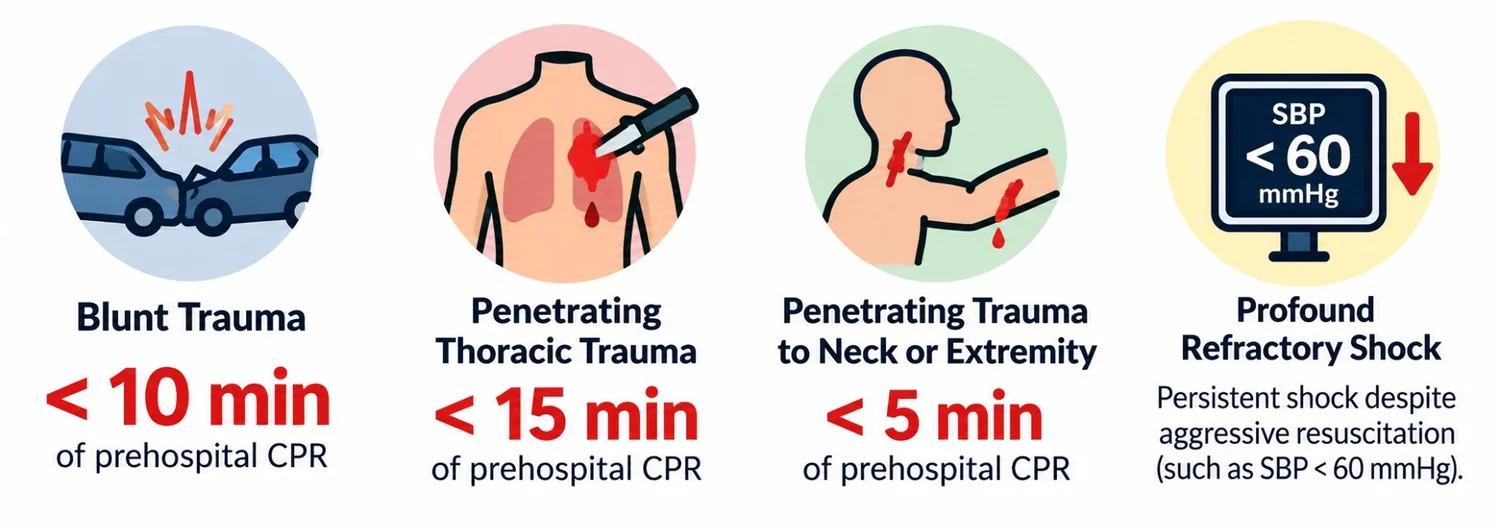
The gray areas
Unfortunately, these guidelines create gray areas (conditional recommendations, time of arrest) that force clinicians to make decisions without adequate support. There are a number of factors to consider in the conditional recommendations, including time from arrest to thoracotomy, premorbid health condition, mechanism of injury and location of major injury (Rhee 2000).
An important factor is determining whether the patient’s traumatic pathology will be amenable to repair during an EDT. For instance, a pericardial tamponade caused by a penetrating ventricular injury may be repaired by an EDT. On the other hand, it is highly unlikely that massive blood loss from a grade 5 liver laceration can be addressed by a thoracotomy. Overall, it is unlikely that an EDT will be able to fix or temporize pathology resulting from penetrating extra-thoracic or blunt trauma.
FAST as a guide
A 2015 study out of LA County Hospital gives us further guidance in this area. Over a 3.5-year period, this group performed 187 EDTs. They found that if the patient had an absence of both pericardial effusion and cardiac activity on the FAST exam, the chance for a good outcome was 0% (the rate of organ donation was similarly 0%) (Inaba 2015). This data is particularly useful when considering the conditional recommendations.
Clinical bottom line
The highest yield for ED resuscitative thoracotomy occurs in penetrating thoracic trauma, while penetrating extra-thoracic trauma and blunt trauma have extremely low rates of good outcomes. The absence of a pericardial effusion and cardiac activity virtually eliminates the utility of an ED resuscitative thoracotomy.
Resources
EM Updates: Indications for ER Thoracotomy
EMCrit: Crack to Cure
John Hinds: Crack the Chest, Get Crucified
References
Seamon MJ, et al. An evidence-based approach to patient selection for emergency department thoracotomy: a practice management guideline from the Eastern Association for the Surgery of Trauma. J Trauma Acute Care Surg. 2015;79(1):159–173. PMID: 26091330
Burlew CC, et al. Western Trauma Association critical decisions in trauma: resuscitative thoracotomy. J Trauma Acute Care Surg. 2012;73(6):1359–1363. PMID: 23188227
Rhee PM, et al. Survival after emergency department thoracotomy: review of published data from the past 25 years. J Am Coll Surg. 2000;190(3):288–298. PMID: 10703853
Inaba K, et al. FAST ultrasound examination as a predictor of outcomes after resuscitative thoracotomy: a prospective evaluation. Ann Surg. 2015;262(3):512–518. PMID: 26258320