

Neonatal resuscitation: the 9th-edition NRP refresher
The Tama–Kong–Giunta NRP roadshow has been working to reach as many of you as possible with the 9th-edition Neonatal Resuscitation Program (NRP) recommendations. This edition puts everything you need in one place for a quick refresher:
the key pearls of neonatal resuscitation
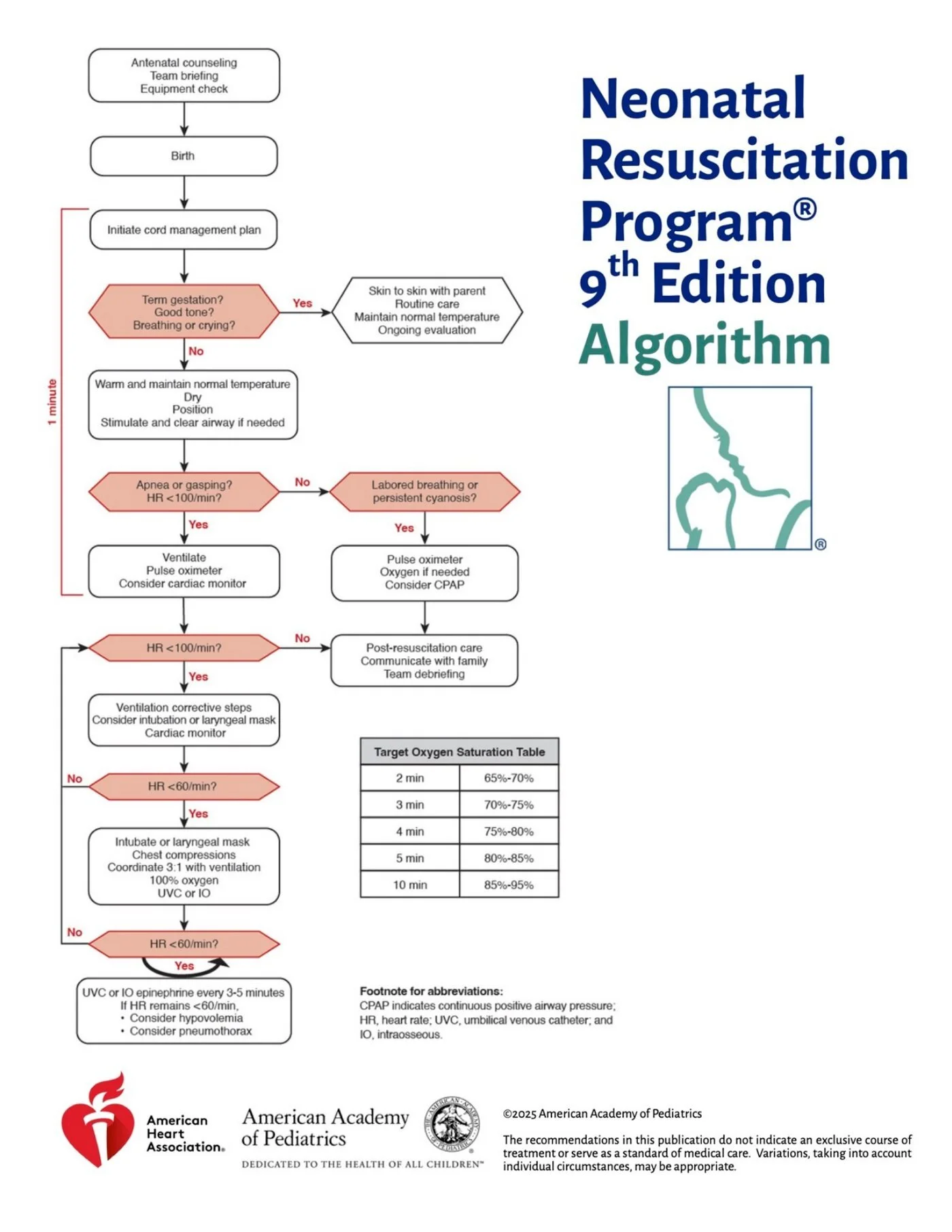
the NRP 9th-edition algorithm
9th-edition practice changes (compared with the 8th edition)
two podcasts that review the NRP updates
Pearls: the warmer
Know how to turn on the warmer (don't forget the switch in the back), and make sure it is connected to oxygen and medical air so the blender works.
The scale function can weigh the baby; just follow the prompts.
Before the baby arrives, use manual mode, which starts 100% heat. When the baby arrives, switch to baby mode and apply the sensor to the baby; the warmer then adjusts itself to keep the baby at 36.5 °C.
You can suction with the Panda or the wall; either is fine.
Connect the T-piece to the port on the lower left side of the Panda. It won't attach to the lower right port.
Pearls: the T-piece
This is the most important part of NRP. You need to know how to do this.
| Setting | Value |
|---|---|
| Flow | 10 L/min |
| PEEP | 5 |
| PIP | 25 |
The T-piece must be capped to adjust the settings.
Holding the T-piece on the baby's face with a good seal (without occluding it for a breath) delivers PEEP of 5 with no PIP.
Ventilation patterns you need to know
HR > 60 (ventilation, no compressions): "Breath – 2 – 3"
HR < 60 (compressions plus ventilation): "1 and 2 and 3 and breath and"
Oxygen
Before compressions, oxygen is typically 21% (term) to 30% (preterm).
When you start compressions, increase oxygen to 100%.
Pearls: medications
Use the neonatal code calculator on the intranet or the pre-printed binder.
Epinephrine dosing is higher in NRP than in PALS.
IV/IO/umbilical epinephrine (0.1 mg/mL): 0.02 mg/kg, followed by a 3 mL NS flush, every 3–5 minutes if HR < 60.
ETT epinephrine (0.1 mg/mL): 0.1 mg/kg by rapid push, not followed by a flush. Give PPV breaths to distribute it into the lungs.
Pearls: the purple OB/neonatal cart
It has everything you need for both baby and mother, including medications in the top drawer.
Umbilical lines are in the access drawer, not with the umbilical line kit.
NRP 9th-edition practice changes
From the AAP/AHA 9th-edition launch summary (released October 22, 2025; institutions encouraged to transition clinical practice by June 1, 2026):
| Topic | 8th edition | 9th edition |
|---|---|---|
| Algorithm | — | Added "Birth" and "Initiate cord management plan" as actions in the first minute; removed suction from "warm, dry, stimulate, position airway, suction if needed" |
| Terminology | Positive-pressure ventilation (PPV) | "Ventilation" (consistent with AHA/AAP guidelines) |
| Deferred cord clamping | Vigorous preterm: delay at least 30–60 s; similar delay may be reasonable for vigorous term | Most newborns not needing immediate resuscitation: defer clamping at least 60 s |
| Umbilical cord milking | Not recommended < 28 weeks (risk of IVH) | Non-vigorous 35–42 weeks: intact cord milking may be a reasonable alternative to early clamping; 28–34 weeks: insufficient evidence; < 28 weeks: not recommended (severe IVH risk) |
| Target SpO₂ table | Starts at 1 min (60–65%) | Starts at 2 min: 65–70%; 3 min 70–75%; 4 min 75–80%; 5 min 80–85%; 10 min 85–95% |
| Initial FiO₂ | ≥ 35 wk 21%; < 35 wk 21–30% | ≥ 35 wk 21%; 32–34 wk 21–30%; < 32 wk ≥ 30% |
| Ventilation rate | 40–60 breaths/min | 30–60 breaths/min |
| Initial PIP | 20–25 cm H₂O | 25 cm H₂O (acceptable range: ≥ 32 wk 25–30; < 32 wk 20–25) |
| Time to corrective steps | HR not increasing within first 15 s of PPV and no chest movement | HR not increasing within 15–30 s of ventilation and no chest movement |
| Ventilation corrective steps | Performed sequentially | Choose and prioritize the steps most likely to help |
| Laryngeal mask | Rescue airway when face mask and intubation fail | May be used as a primary ventilation device (face mask or laryngeal mask) |
| ETT size | < 1 kg 2.5; 1–2 kg 3.0; > 2 kg 3.5 | < 800 g 2.5 (2.0 optional); 800–1,200 g 2.5; 1,201–2,200 g 3.0; > 2,200 g 3.5 |
| ETT depth | Marking at the lip (tip-to-lip) | Marking at the anterior edge of the upper (maxillary) gum in the midline (tip-to-gum) |
Listen
Clinical pearls
Master the T-piece: flow 10, PEEP 5, PIP 25. Ventilation is the most important intervention in neonatal resuscitation.
"Breath–2–3" when HR > 60; "1-and-2-and-3-and-breath" when HR < 60, and turn oxygen up to 100% when compressions start.
Neonatal epinephrine: 0.02 mg/kg IV/UVC/IO with a flush, or 0.1 mg/kg ETT without a flush.
Prepare the warmer before the baby arrives: manual mode first, then baby mode with the skin sensor.
