

Why it matters
We see it often: hyperglycemia + altered mental status + abdominal pain. We know the drill: get the VBG, start fluids, check the potassium, and make sure the β-hydroxybutyrate was sent. Often the pH comes back low, the glucose comes back high, the potassium is just right to start the insulin drip, and the patient goes to the MICU.
But what do you do when you thought it was a sure DKA and the pH is 7.34 with a β-hydroxybutyrate of 0.9? Or when the pH is 7.0 but the serum osmolality is 450?
DKA and HHS are both large topics, covering management, complications, and precipitating factors. This review focuses on the basics of each and what to do when the picture is mixed.
Clinical scenario
A 57-year-old man with an unknown medical history is brought in by EMS for altered mental status. Per his daughter, he was not feeling well last night. A family friend went to check on him this morning and he did not answer the door; police performing a wellness check found him minimally responsive on the floor. His fingerstick glucose on arrival is > 600.
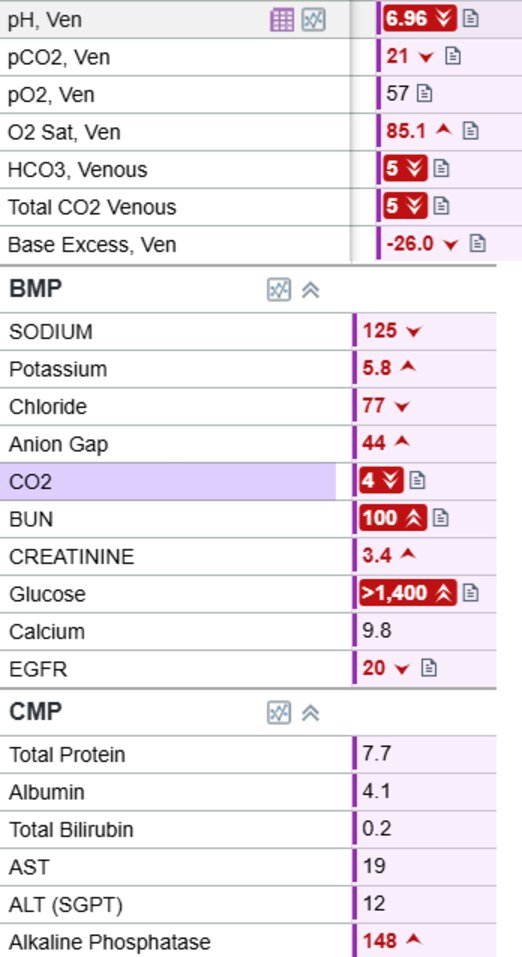
| Test | Result |
|---|---|
| pH (venous) | 6.96 |
| pCO₂ / pO₂ (venous) | 21 / 57 |
| HCO₃ (venous) / total CO₂ | 5 / 5 |
| Base excess | −26.0 |
| Sodium / potassium / chloride | 125 / 5.8 / 77 |
| Anion gap | 44 |
| BUN / creatinine | 100 / 3.4 |
| Glucose | > 1,400 |
| Calcium / albumin | 9.8 / 4.1 |
| β-Hydroxybutyrate | > 9.0 |
| Serum osmolality | 415 |
| Lipase | 1,787 |
| Troponin | 36 |
Other results: venous O₂ saturation 85.1, eGFR 20, total protein 7.7, total bilirubin 0.2, AST 19, ALT 12, alkaline phosphatase 148.
Definitions (2024 consensus guidelines)
Definitions of DKA vary across articles and guidelines, which adds to an already complex diagnosis. The 2024 consensus guideline definitions are below.
DKA requires all 3 components
Diabetes or hyperglycemia: glucose > 200 mg/dL or a prior history of diabetes.
Remember that DKA can present with a normal glucose (euglycemic DKA).
Ketosis: β-hydroxybutyrate > 3 mmol/L or urine ketones 2+ or greater.
Metabolic acidosis: pH < 7.3 and/or bicarbonate < 18 mmol/L.
This can be misleading. Patients who are also vomiting develop a concurrent metabolic alkalosis and may keep a normal pH and bicarbonate. Even with a normal pH and bicarbonate, an elevated anion gap and β-hydroxybutyrate still mean metabolic acidosis.
HHS requires all 3 components
Profound hyperglycemia: usually glucose > 600 mM.
Serum osmolarity > 320 mM.
Absence of substantial ketoacidosis, by either:
β-hydroxybutyrate < 3 mmol/L, or
anion gap < 15.
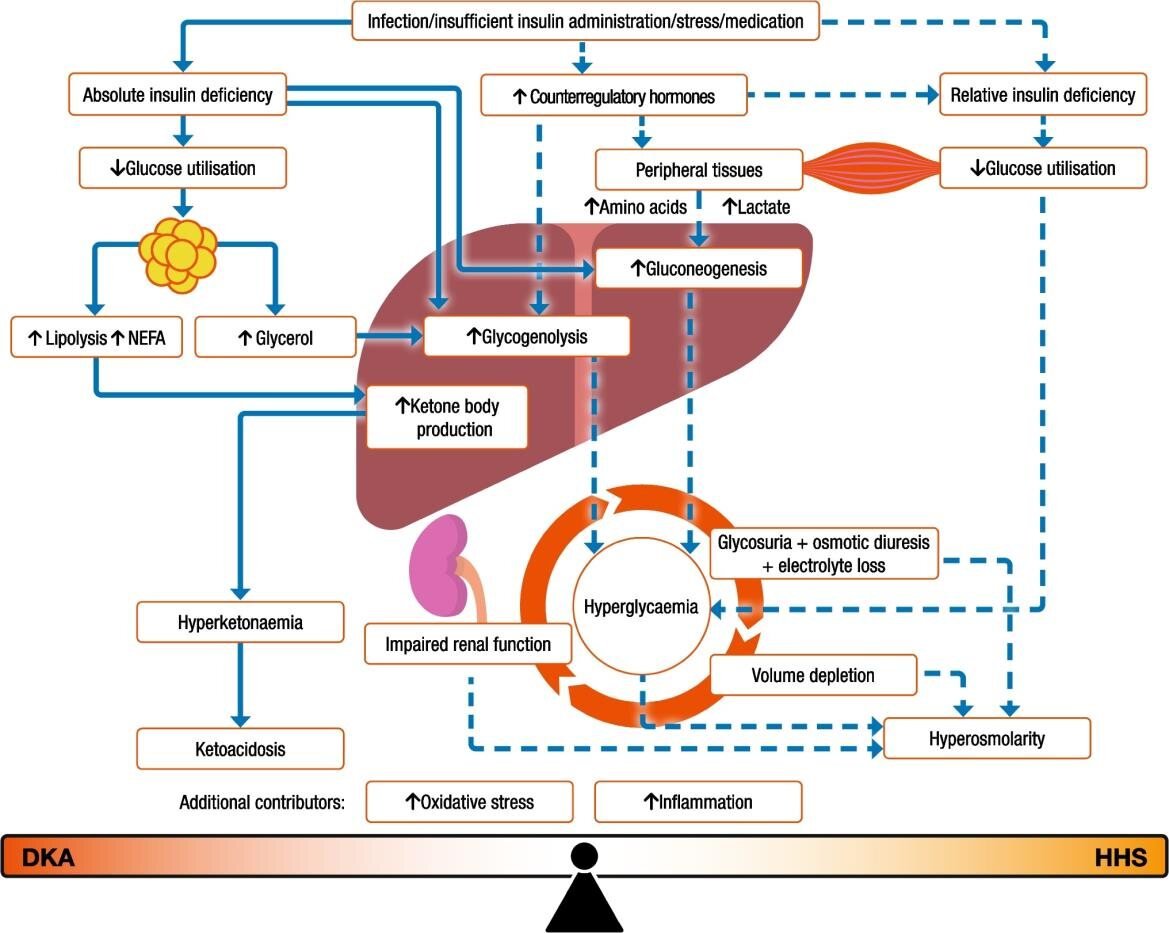
Pathophysiology: it comes down to insulin
HHS: relative insulin insufficiency. Some insulin is still available, so the body becomes hyperglycemic without being forced to use other fuel sources. As glucose rises it spills into the urine and pulls water with it (osmotic diuresis), causing profound dehydration, the main problem in HHS.
DKA: essentially no insulin is available, so the body turns to other fuel sources (fatty acids and glycogen), which are eventually metabolized to ketones that cause acidosis.
The mixed picture
Up to 30% of patients with DKA may also have features of HHS.
A mixed DKA/HHS patient has an elevated β-hydroxybutyrate (> 3 mmol/L) with hyperosmolality (serum osmolality > 320 mOsm/kg).
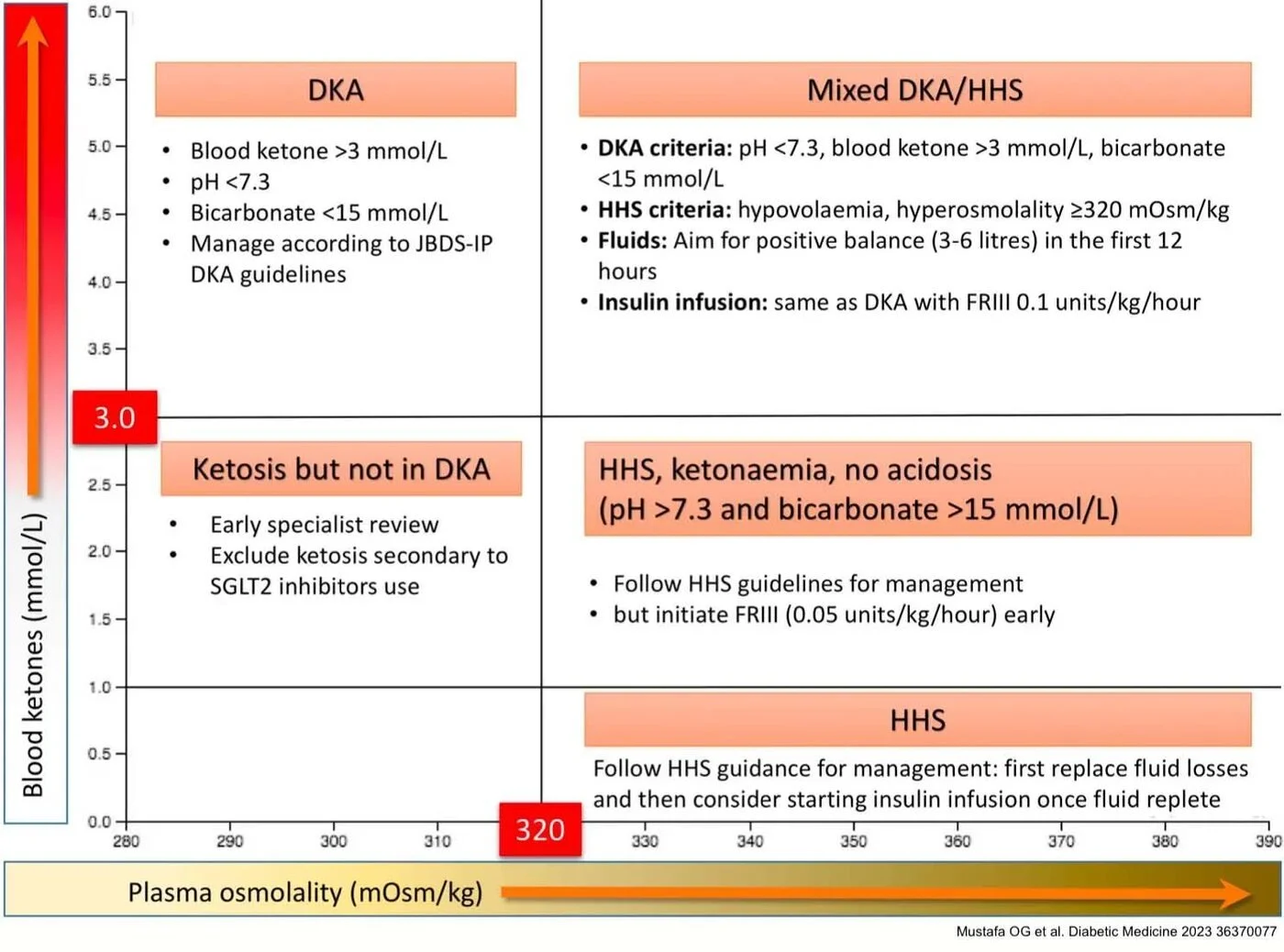
Treating mixed DKA/HHS: treat what predominates
Marked ketoacidosis with mildly elevated osmolality: manage with a DKA treatment algorithm.
Marked hypertonicity with mild ketoacidosis: manage with an HHS algorithm, with the modification that the insulin infusion is started immediately.
Don't miss the trigger
The most important part of treating DKA or HHS is making sure no underlying process is missed: sepsis, pancreatitis, myocardial infarction, stroke, and so on. HHS carries a mortality of about 15%, largely from comorbid problems and triggers, not from HHS alone.
Addendum: a strong ion (Stewart) view of this case
Contributed by Dr. Xun (Shawn) Zhong.
For those who use the strong ion (Stewart) approach to acid–base: in this case, with a base deficit of 26, a strong ion difference of 48, and a near-normal albumin (assuming a normal lactate, which was not shown), the strong ion gap is 36.
The β-hydroxybutyrate is reported only as "> 9," which does not say how high it is. The strong ion gap suggests it is likely in the 30s.
Clinical pearls
DKA = hyperglycemia (or known diabetes) + ketosis + acidosis. HHS = profound hyperglycemia + osmolality > 320 + no substantial ketoacidosis.
A normal pH does not rule out DKA in a vomiting patient. Look at the anion gap and β-hydroxybutyrate.
Mixed DKA/HHS is common. Treat whichever process predominates, and in HHS-predominant mixed cases start insulin right away.
Always look for the trigger. It drives HHS mortality.
