

Vancomycin: overused and misunderstood
Vancomycin is one of our go-to antibiotics in the ED. Yet much of what we give in the ED is not continued by the inpatient team, and much of it is underdosed. Who should get vancomycin, and how much?
Mechanism and indications
A glycopeptide that inhibits cell-wall synthesis.
IV vancomycin is indicated for serious gram-positive infections: Staphylococcus (especially MRSA), Streptococcus, and most Enterococcus strains.
It remains the drug of choice for serious, deep-seated MRSA infections.
It is indicated for empiric treatment of possible meningitis in children and adults in the ED.
MRSA risk factors
Hemodialysis
IV drug use
Prior MRSA infection
Indwelling catheter
Contact sports
Crowded living conditions (homeless shelters, prisons, military)
Recent antibiotic use
Residence in a long-term care facility
Recent hospitalization or surgery
ED cases where vancomycin is a good choice
Diabetic foot ulcer, osteomyelitis, infected decubitus ulcer, suspected endocarditis, pneumonia with skin rash or effusion, skin infections, meningitis, epidural infections, the febrile renal patient or person who injects drugs, and line infections.
Dosing: where the ED gets it wrong
One ED study found the initial dose was 1 g in 92% of cases, and patients were underdosed 78% of the time (Fuller 2013).
Initial adult dosing should never be below 15 mg/kg and should always be based on actual body weight.
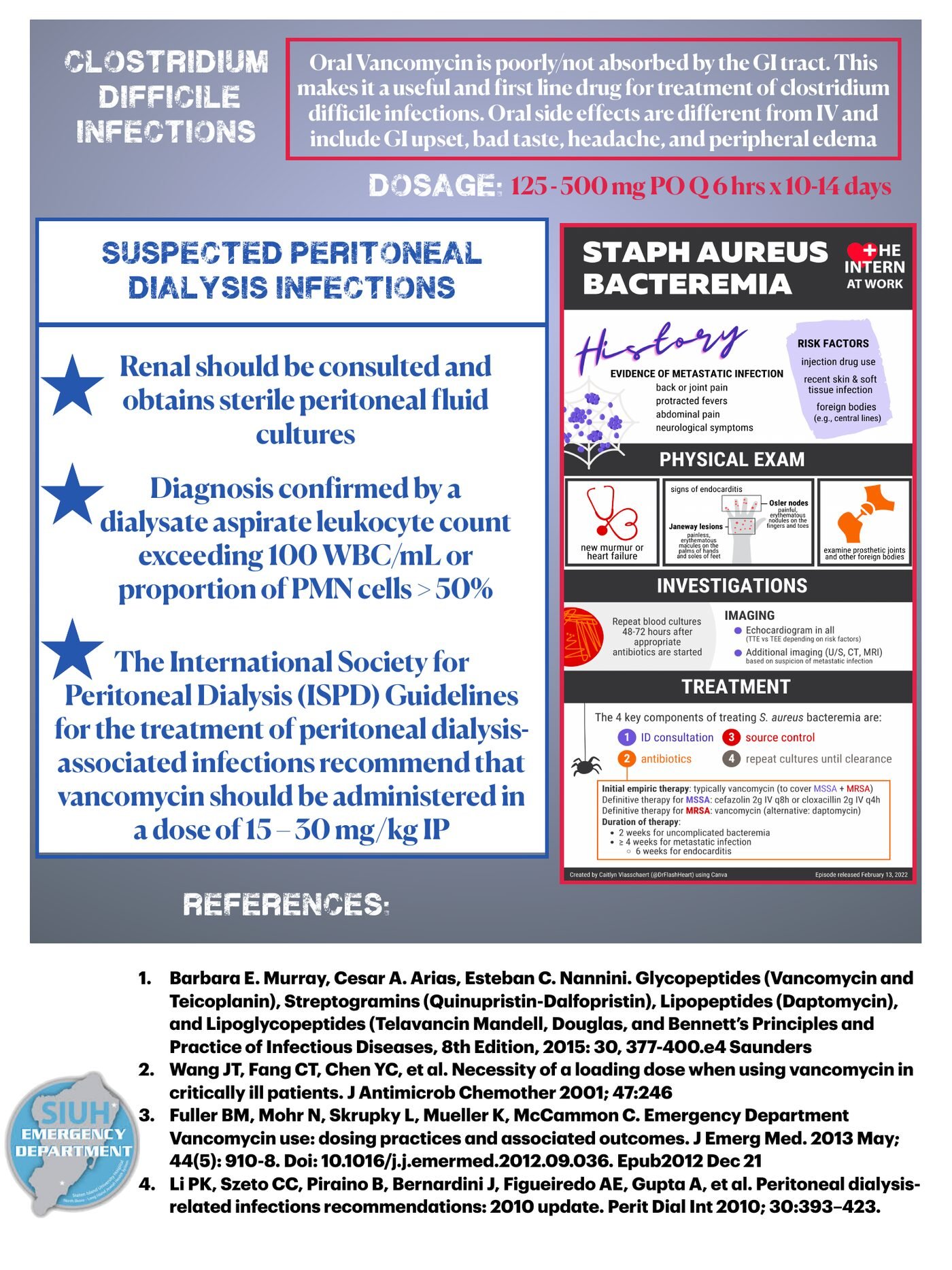
Loading dose: 25–30 mg/kg (actual body weight) for serious infections such as vertebral osteomyelitis, MRSA pneumonia, epidural abscess, and septic shock. The maximum is usually 2–3 g (sources vary), rounded to the nearest 250 mg.
IDSA recommends an even higher loading dose for patients who are critically ill, on renal replacement therapy, or receiving continuous infusion.
Vancomycin pearl: in critically ill patients with renal insufficiency, do not reduce the loading dose. Subsequent doses are adjusted for renal function and serum levels.
Should I give a one-time dose in the ED?
No. A single dose has no proven benefit and is not recommended by IDSA:
It is unlikely to reach therapeutic target concentrations.
It increases ED length of stay and cost, and promotes vancomycin resistance.
Administration and adverse effects
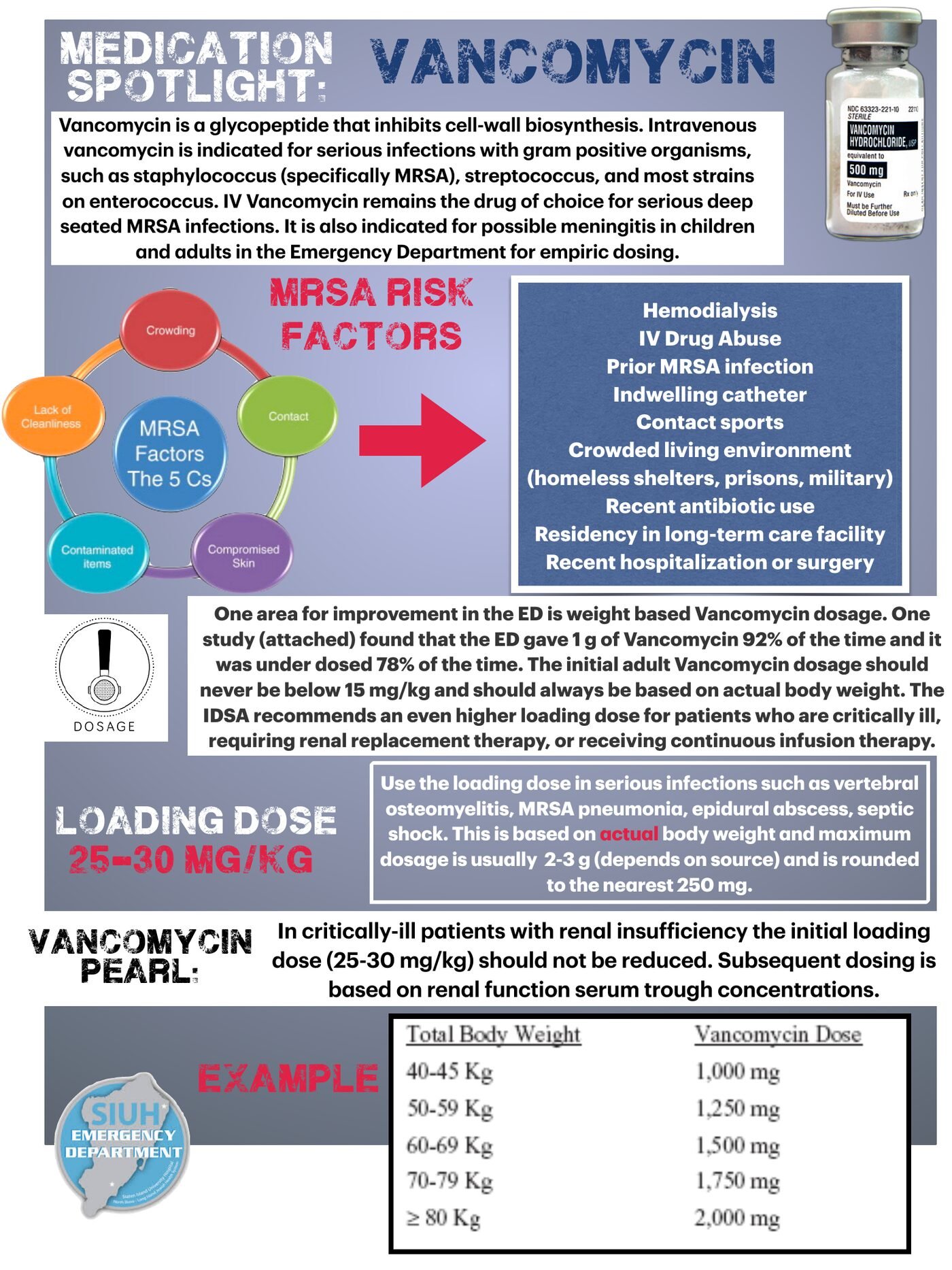
Never infuse faster than over 1 hour in children or adults. In adults, do not exceed 10 mg/min.
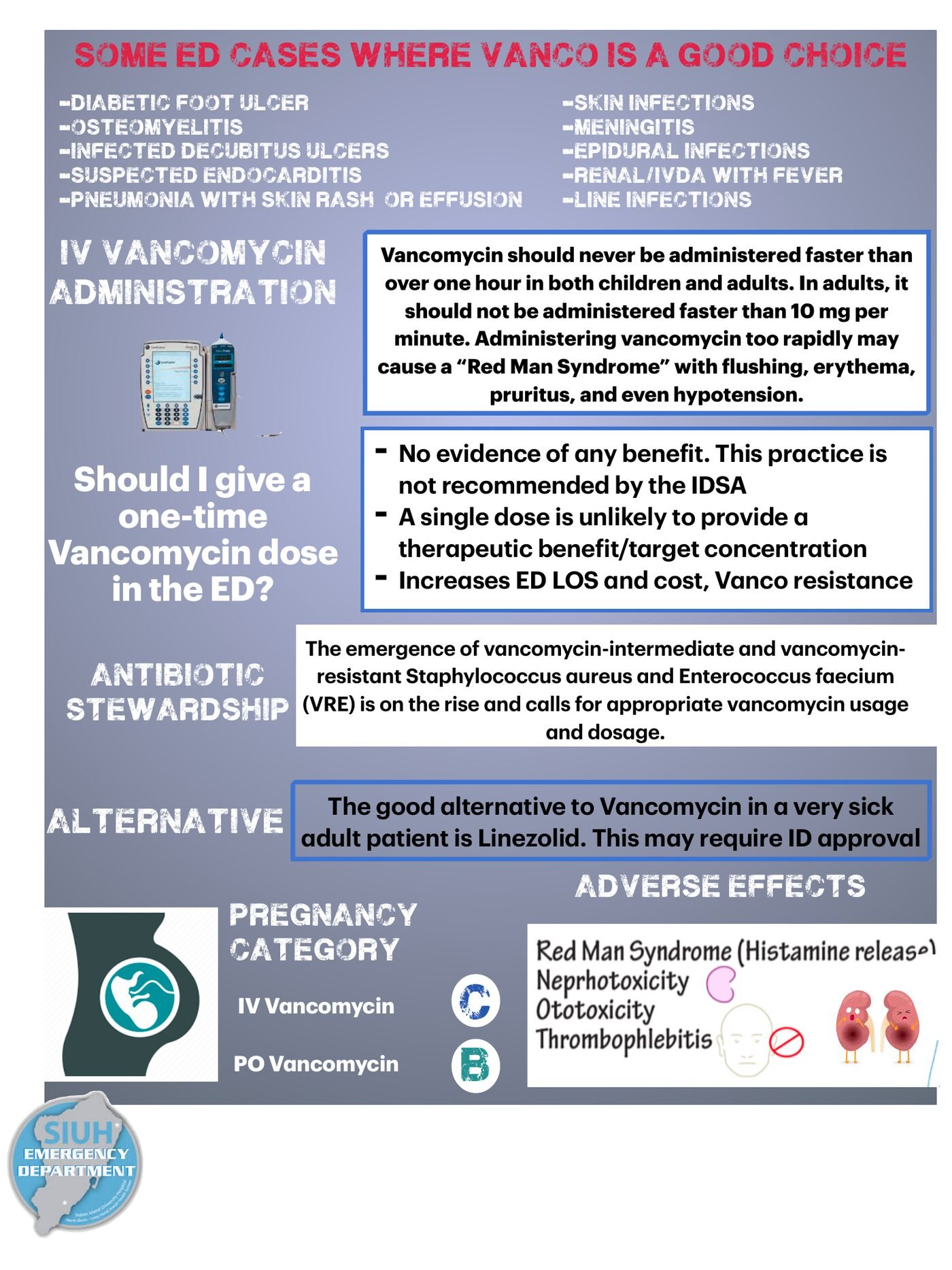
Rapid infusion can cause vancomycin infusion reaction (formerly "red man syndrome"): flushing, erythema, pruritus, and even hypotension.
Alternative
Linezolid is a good alternative to vancomycin in a very sick adult. It may require ID approval.
Antibiotic stewardship
Vancomycin-intermediate and vancomycin-resistant S. aureus, and vancomycin-resistant Enterococcus faecium (VRE), are increasing. That makes appropriate use and dosing important.
Special situations
Clostridioides difficile infection
Oral vancomycin is poorly absorbed from the GI tract, which makes it a first-line treatment for C. difficile. Per IDSA/SHEA guidelines: 125 mg PO four times daily for 10 days. For fulminant infection: 500 mg PO (or by nasogastric tube) four times daily, with IV metronidazole. The 2021 IDSA/SHEA update prefers fidaxomicin for an initial episode when available; vancomycin remains an acceptable alternative (McDonald 2018; Johnson 2021). Oral side effects differ from IV and include GI upset, bad taste, headache, and peripheral edema.
Suspected peritoneal dialysis peritonitis
Consult nephrology and obtain sterile peritoneal fluid cultures.
The diagnosis is confirmed by a dialysate leukocyte count > 100 WBC/µL or > 50% PMNs.
ISPD guidelines recommend intraperitoneal vancomycin 15–30 mg/kg.
Clinical pearls
Weight-based, every time: 25–30 mg/kg load for serious infection, never under 15 mg/kg.
Don't cut the load for renal failure.
No "one and done" vancomycin. If the patient doesn't need ongoing therapy, they probably don't need the ED dose.
References
Murray BE, Arias CA, Nannini EC. Glycopeptides (vancomycin and teicoplanin), streptogramins (quinupristin-dalfopristin), lipopeptides (daptomycin), and lipoglycopeptides (telavancin). In: Mandell, Douglas, and Bennett's Principles and Practice of Infectious Diseases. 8th ed. Saunders; 2015:377–400.e4.
Wang JT, Fang CT, Chen YC, et al. Necessity of a loading dose when using vancomycin in critically ill patients. J Antimicrob Chemother. 2001;47:246.
Fuller BM, Mohr N, Skrupky L, Mueller K, McCammon C. Emergency department vancomycin use: dosing practices and associated outcomes. J Emerg Med. 2013;44(5):910–918. doi:10.1016/j.jemermed.2012.09.036
Li PK, Szeto CC, Piraino B, et al. Peritoneal dialysis-related infections recommendations: 2010 update. Perit Dial Int. 2010;30:393–423.
