

Pressure's on: a "bloody" good case
A previously healthy 17-year-old boy presents to the pediatric ED with painless bloody urine for the past 3 hours. Urine output is normal. His mother thinks his eyes "look puffy" today. He denies dysuria, frequency, flank trauma, abdominal pain, fever, vomiting or diarrhea, and recent vigorous exercise. He has no history of kidney disease.
About 3 weeks ago he had a sore throat with fever and difficulty swallowing. His pediatrician's rapid strep test was negative, no throat culture was sent, and he was not treated with antibiotics. The throat symptoms resolved completely after several days.
Vital signs
T 37.0 °C
HR 82/min
RR 18/min
BP 148/92 mmHg
SpO₂ 99% on room air
Weight unchanged from baseline
Exam
Well appearing, in no acute distress.
Mild periorbital edema; no significant peripheral edema.
Normal cardiopulmonary exam, without crackles or gallop.
Soft, non-tender abdomen. No rash or joint swelling.
Urinalysis


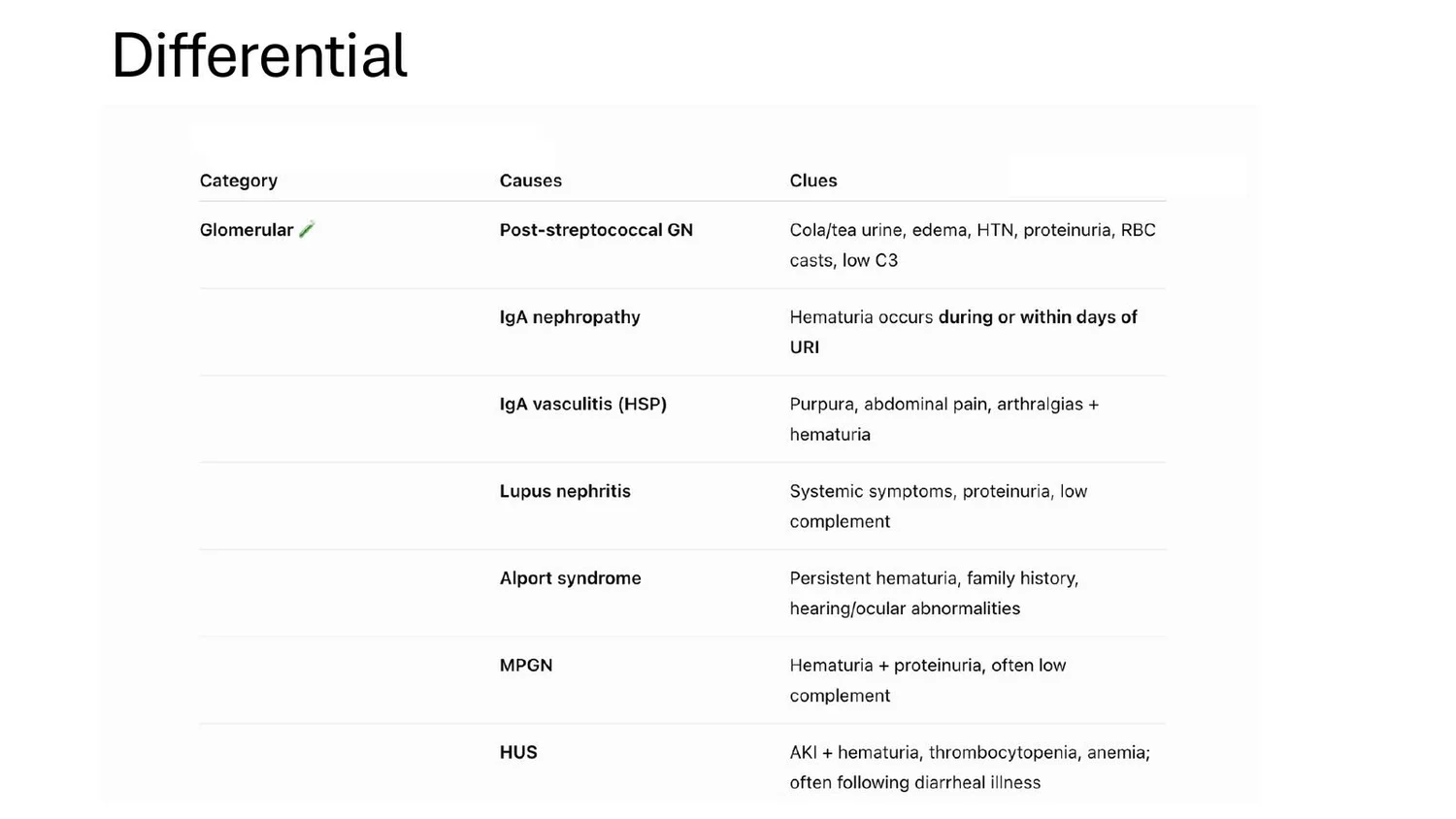
Differential diagnosis: rhabdomyolysis, UTI, nephrolithiasis, and post-streptococcal glomerulonephritis (PSGN).
Labs


CK 139 (0–225)
POCUS of the kidneys and bladder shows no hydronephrosis or other abnormality.


Your earlier differentials have been ruled out. What tests help diagnose nephritis?
Complement levels, urine microscopy for RBC casts, and evidence of recent strep infection.
ASO 1,464 (0–199)
C3 112 (81–157)
C4 16 (13–39)
However complex the laboratory evaluation, the ED's job is to make sure the patient is not volume overloaded, hypertensive, or in significant AKI.
Approaching nephritis in the ED: "Blood + BP + BUN"
Blood
Confirm true hematuria with a urinalysis and microscopy. Casts favor a glomerular cause.
| Dipstick | Microscopy | Think |
|---|---|---|
| + blood | Many RBCs | True hematuria |
| + blood | Few or no RBCs | Myoglobinuria or hemoglobinuria |
| − blood | RBCs present | A testing or collection issue, or unusual circumstances |
BP
Volume overload: periorbital or lower-extremity edema, respiratory distress or crackles, weight gain, decreased urine output.
Hypertension: use age-based norms. For patients 13 years and older, hypertension is ≥ 130/80 mmHg.
BUN
Is there AKI or azotemia? Check electrolytes, BUN, and creatinine.
Disposition: admission criteria
Severe hypertension
Significant AKI
Electrolyte abnormalities
Altered mental status
Pulmonary edema
Unreliable outpatient follow-up
Patients may need admission for the complications of nephritis, not for the disease itself.
Tama's tips
The ED physician's job is less about treating glomerulonephritis and more about recognizing it, confirming the likely diagnosis, identifying complications, controlling volume and blood pressure, and deciding whether the patient can be safely monitored as an outpatient.
Make that decision with pediatric nephrology.
Most children recover renal function over the following weeks. Microscopic hematuria can persist for several months.
What would your disposition be for this patient?
