

Inhaled nitric oxide (iNO) for pulmonary hypertension crisis
This edition covers one of the most unforgiving situations we manage, pulmonary hypertension (PH) crisis and acute high-risk PE with RV failure, and the role of inhaled nitric oxide as a bridge.
Clinical scenario
An 80-year-old woman with known severe PH on home treprostinil, chronic diastolic heart failure, and interstitial lung disease arrives in extremis: SpO₂ 84%, BP 88/56, HR 128. Bedside POCUS shows a dilated, poorly contracting RV with septal flattening. One liter of IV fluid is ordered and she is placed on a non-rebreather.
BiPAP, HFNC, or intubation?
Should she have received IV fluids, or pressors?
What can you reach for in the ED that will meaningfully change her hemodynamics?
What is pulmonary hypertension?
Abnormally high pressure in the pulmonary arteries (mPAP > 20 mmHg on right heart catheterization).
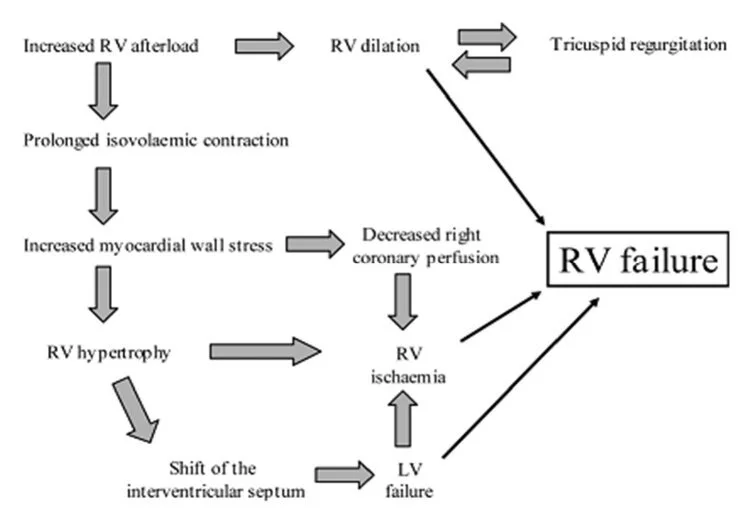
Persistently elevated pressure increases RV afterload, and over time the RV strains, weakens, and can fail.
Note: the pulmonary arteries carry blood for gas exchange. They do not nourish the lung tissue itself; that is the job of the bronchial arteries, which come off the systemic circulation.
Why the RV becomes ischemic
Normally the right coronary artery (RCA) perfuses the RV in both systole and diastole, because aortic pressure, even at its diastolic low point, is always higher than peak RV pressure (about 20 mmHg). In PH, peak RV/PA systolic pressure rises enough that, at times in the cardiac cycle, aortic pressure no longer exceeds RV pressure, and RV perfusion stops.
Hemodynamic goal: keep the lowest aortic pressure (diastolic) above the highest RV pressure (PA systolic). A PA catheter, if available, can guide this directly.
Echo findings of RV failure
Apical 4-chamber: RV-to-LV size ratio and RV morphology.
McConnell's sign (apical sparing with free-wall hypokinesis) is associated with acute RV pressure overload and ischemia. It is not pathognomonic for PE.
Parasternal short axis (mid-papillary): septal flattening or bowing, the "D-sign," indicating RV pressure or volume overload.
Plethoric, non-collapsing IVC suggests elevated right atrial pressure, independent of volume status.
ED management
1. Optimize oxygenation and ventilation first
Drips take time to set up. Airway and breathing win or lose these patients before the pressors arrive.
Start with HFNC. Hypoxia and hypercapnia both drive pulmonary vasoconstriction and raise PVR.
Avoid intubation until forced. Do not intubate because the patient "looks bad" or for anticipated course; intubate only when arrest is imminent. Peri-intubation hemodynamic collapse is common in severe PH.
If NIPPV is needed for atelectasis-driven hypoxia (shunt physiology), use a ventilator on PS/CPAP mode rather than a dedicated NIPPV machine, which typically will not go below EPAP 4. Stay at the bedside and titrate PEEP/EPAP up slowly. Recruiting atelectasis can improve blood flow and lower PA pressure.
If intubation is unavoidable: use the lowest possible airway pressures (PEEP 0 if tolerated), sit the patient up to 90°, and aggressively avoid hypercapnia.
2. Optimize volume status
Assess with POCUS before giving fluids or diuresing. Most PH-crisis patients are volume overloaded, not dry.
3. Maintain MAP with vasopressors, early
The goal is SVR > PVR, preserving RCA perfusion throughout the cardiac cycle. Do not chase fluids in a hypotensive PH patient. The RV-friendly combination is vasopressin plus epinephrine.
Vasopressin 0.01–0.04 units/min (first line): raises SVR through V₁ receptors with minimal effect on PVR. It is not safe peripherally and has a low ceiling, so it runs alongside epinephrine rather than alone. Keep it ≤ 0.04 units/min.
Low-dose epinephrine, start 0.01–0.1 mcg/kg/min and titrate (second line): its β₁ inotropy supports the failing RV, and at low doses it has little α₁ effect. β₂ activity may cause mild pulmonary vasodilation. Watch for tachyarrhythmias: losing sinus rhythm is catastrophic for a strained RV.
Avoid α-predominant agents. Phenylephrine raises PVR more than SVR and worsens RV–PA coupling. Do not use it, including as a push-dose agent at intubation. Norepinephrine is less harmful but still α-predominant and can raise PVR at higher doses. Use it only if vasopressin plus epinephrine is insufficient, or when sepsis is clearly driving the shock.
4. Add an inotrope if cardiac output remains poor
Signs include cool extremities, lactic acidosis, or persistent RV dilation on POCUS despite an adequate MAP. Low-dose epinephrine is often already doing this job.
Dobutamine 2–5 mcg/kg/min: β₁ inotropy with mild pulmonary vasodilation. It lowers SVR, so keep vasopressin (and/or epinephrine) running.
Milrinone: lowers PA pressure and increases contractility. It is reasonable to start in the ED if the patient is going to the ICU and pressors are already running. Expect hypotension within about 30 minutes as SVR falls. Do not start it alone.
5. Reduce RV afterload
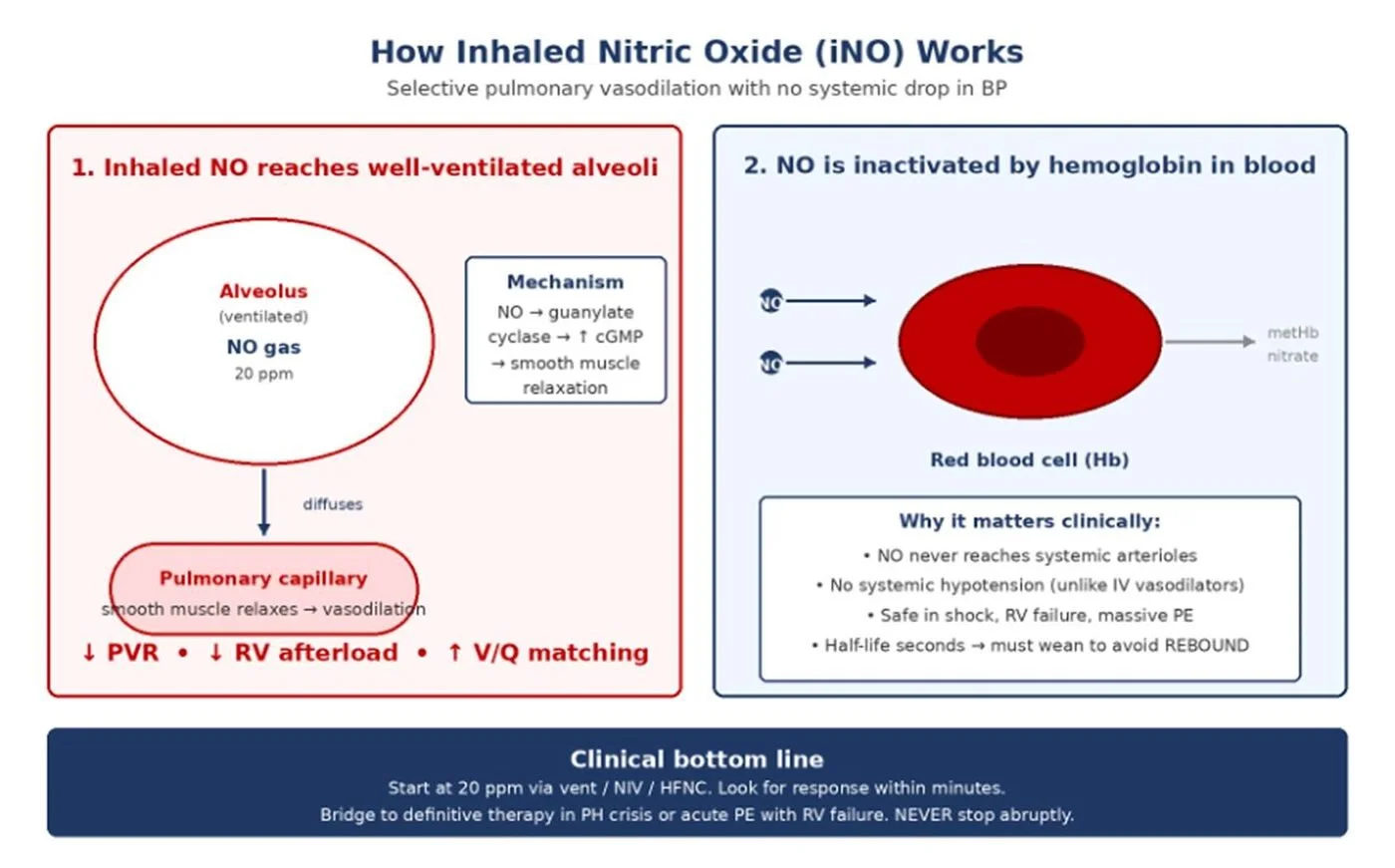
Inhaled pulmonary vasodilators (iNO, epoprostenol, iloprost) are preferred in the critically ill. They lower PVR selectively in ventilated lung regions, which improves V/Q matching without systemic hypotension.
What is inhaled nitric oxide?
Nitric oxide diffuses into pulmonary arteriolar smooth muscle, raises cGMP, and causes vasodilation. Two properties make it ideal for the crashing patient:
It is rapidly inactivated by hemoglobin, so the effect stays in the lungs and causes no systemic hypotension.
It reaches only ventilated alveoli, so it improves V/Q matching as well as lowering PVR.
When to use iNO
PH crisis/decompensated RV failure: an acute rise in PVR with falling cardiac output, often triggered by infection, arrhythmia, dehydration, or interruption of a prostacyclin infusion. The 2009 ACCF/AHA expert consensus recognizes iNO as a selective pulmonary vasodilator for vasoreactivity testing and acute management.
Massive or high-risk submassive PE with RV dysfunction: case series show rapid improvement in oxygenation and pulmonary hemodynamics. The 2011 AHA scientific statement notes inhaled pulmonary vasodilators may be useful adjuncts for refractory hypoxemia with RV dysfunction. Use iNO as a bridge. It does not replace anticoagulation, thrombolysis, catheter-directed therapy, surgical embolectomy, or ECMO.
Other rescue uses: RV failure after cardiac surgery, refractory hypoxemia in ARDS (improves PaO₂/FiO₂ but not mortality), and RV failure on mechanical support.
Dosing and administration
| Parameter | Detail |
|---|---|
| Starting dose | 20 ppm (range 5–40 ppm; > 40 ppm adds no benefit and increases toxicity) |
| Onset | Minutes. Assess response in 10–20 min; stop if no improvement |
| Delivery | Ventilator circuit, NIV mask, or HFNC. Intubation is not required, and should be avoided if possible |
| Signs of response | ↑ SpO₂, ↓ HR, ↑ BP, smaller RV on repeat POCUS |
Call respiratory therapy and pharmacy early. Setup is not instantaneous, and iNO must be delivered through an FDA-cleared nitric oxide delivery system.
Watch out for
Methemoglobinemia: check methemoglobin by co-oximetry at 4–8 hours, then daily. If > 5%, reduce the dose. If symptomatic or > 7–10%, stop iNO and give methylene blue 1–2 mg/kg IV.
NO₂ formation: the delivery system measures inspired NO₂. Keep it < 3 ppm, and lower iNO or FiO₂ if it climbs.
Rebound pulmonary hypertension: never stop iNO abruptly. Wean stepwise (20 → 10 → 5 → 2 → 1 ppm) once FiO₂ ≤ 0.5 and the patient is stable. If the patient deteriorates during the wean, restart at the last effective dose.
LV dysfunction: the sudden drop in PVR delivers more preload to a stiff or failing left ventricle, which can cause flash pulmonary edema. Be very cautious starting iNO without inotropic support in patients with low EF.
If iNO is not stocked: inhaled epoprostenol (50 ng/kg/min nebulized) has comparable efficacy and is substantially cheaper.
Bottom line
iNO is a selective pulmonary vasodilator. It lowers PVR, unloads the RV, and improves V/Q without dropping systemic BP.
Use it as a bridge in PH crisis and in acute PE with RV failure while definitive therapy is arranged.
Do not start iNO without inotropic support on board.
Start at 20 ppm, assess within minutes, and never stop abruptly.
In these patients, intubation is the last resort, not the first.
References
1. McLaughlin VV, Archer SL, Badesch DB, et al. ACCF/AHA 2009 expert consensus document on pulmonary hypertension. J Am Coll Cardiol. 2009;53(17):1573–1619.
2. Jaff MR, McMurtry MS, Archer SL, et al. Management of massive and submassive pulmonary embolism, iliofemoral deep vein thrombosis, and chronic thromboembolic pulmonary hypertension: a scientific statement from the American Heart Association. Circulation. 2011;123(16):1788–1830.
3. Ventetuolo CE, Klinger JR. Management of acute right ventricular failure in the intensive care unit. Ann Am Thorac Soc. 2014;11(5):811–822.
4. Price LC, Wort SJ, Finney SJ, Marino PS, Brett SJ. Pulmonary vascular and right ventricular dysfunction in adult critical care: current and emerging options for management: a systematic literature review. Crit Care. 2010;14(5):R169.
5. Hoeper MM, Granton J. Intensive care unit management of patients with severe pulmonary hypertension and right heart failure. Am J Respir Crit Care Med. 2011;184(10):1114–1124.
6. Houston BA, Brittain EL, Tedford RJ. Right ventricular failure. N Engl J Med. 2023;388(12):1111–1125.
7. Wilcox SR, Kabrhel C, Channick RN. Pulmonary hypertension and right ventricular failure in emergency medicine. Ann Emerg Med. 2015;66(6):619–628.
8. Olsson KM, Halank M, Egenlauf B, et al. Decompensated right heart failure, intensive care and perioperative management in patients with pulmonary hypertension: updated recommendations from the Cologne Consensus Conference 2018. Int J Cardiol. 2018;272S:46–52.
9. Ichinose F, Roberts JD Jr, Zapol WM. Inhaled nitric oxide: a selective pulmonary vasodilator. Circulation. 2004;109(25):3106–3111.
10. Kline JA, Puskarich MA, Jones AE, et al. Inhaled nitric oxide to treat intermediate risk pulmonary embolism: a multicenter randomized controlled trial (iNOPE). Nitric Oxide. 2019;84:60–68.
11. Lyhne MD, Kline JA, Nielsen-Kudsk JE, Andersen A. Pulmonary vasodilation in acute pulmonary embolism: a systematic review. Pulm Circ. 2020;10(1):2045894019899775.
12. Humbert M, Kovacs G, Hoeper MM, et al. 2022 ESC/ERS guidelines for the diagnosis and treatment of pulmonary hypertension. Eur Heart J. 2022;43(38):3618–3731.
13. Le Tulzo Y, Seguin P, Gacouin A, et al. Effects of epinephrine on right ventricular function in patients with severe septic shock and right ventricular failure. Intensive Care Med. 1997;23(6):664–670.
14. INOmax (nitric oxide) [package insert]. Mallinckrodt Pharmaceuticals.
15. Farkas J. Right ventricular failure. Internet Book of Critical Care (IBCC), EMCrit. Updated March 2025.
16. Farkas J. Intermediate & high-risk pulmonary embolism. Internet Book of Critical Care (IBCC), EMCrit. Updated 2026.
