

Clinical scenario
You are on a solo critical care shift when a 70-year-old arrives by EMS in respiratory distress. The patient became short of breath suddenly, with an oxygen saturation of 82% on room air. EMS applied CPAP, and breathing and saturation improved to 95%. The patient has rales, is tachycardic, and has a BP of 210/100 mmHg. You call respiratory therapy for BiPAP, and they ask what settings to start.
Before answering with the reflexive "10 over 5," or jumping to intubation, step back. Choosing BiPAP settings, and knowing when to intubate, depends on the underlying physiology and on all the non-invasive options available.
Why do patients with respiratory failure need intubation?
1. Refractory hypoxemia: inability to oxygenate despite respiratory support, including non-invasive options such as BiPAP or HFNC.
2. CO₂ narcosis (hypercapnic encephalopathy): very high CO₂ levels, usually with pCO₂ above 100 mmHg, cause altered mental status and eventually obtundation.
3. Respiratory muscle fatigue: prolonged increased work of breathing exhausts the muscles. As the diaphragm fails, the patient cannot cough or clear secretions, leading to mucus plugging and further deterioration.
The goal of non-invasive ventilation is to improve oxygenation and ventilation (lower CO₂), and to support breathing long enough for the respiratory muscles to recover, so that intubation is avoided.
Definitions
NIPPV (non-invasive positive pressure ventilation): a broad term for positive pressure delivered through a tight-fitting face or nasal mask.
CPAP (continuous positive airway pressure): constant pressure throughout the respiratory cycle, which recruits alveoli and improves oxygenation.
BiPAP (bilevel positive airway pressure): separately titratable inspiratory (IPAP) and expiratory (EPAP) pressures. The difference between them augments tidal volume and improves ventilation.
AVAPS (average volume-assured pressure support): a BiPAP mode that automatically adjusts inspiratory pressure to maintain a preset target tidal volume or minute ventilation.
HFNC (high-flow nasal cannula): heated, humidified oxygen at 30–80 L/min. Generates low-level positive airway pressure (about 3–5 cm H₂O) and washes out dead space.
IPAP, EPAP, and pressure support
IPAP assists inspiration by increasing the pressure gradient between the mouth and alveoli. This directly augments tidal volume, improves CO₂ clearance, unloads the respiratory muscles, and reduces work of breathing.
EPAP works like PEEP. It maintains positive pressure during expiration to prevent airway collapse, recruit alveoli, and improve oxygenation.
Pressure support (PS) = IPAP − EPAP. PS determines how much tidal volume the machine helps deliver. Raising PS makes it easier for the patient to take larger breaths.
Titration
| Problem | Adjustment |
|---|---|
| Hypercapnia | Increase IPAP |
| Hypoxemia | Increase EPAP |
| High work of breathing | Increase pressure support (raise IPAP, keep EPAP) |
BiPAP is patient-driven. The patient's effort determines respiratory rate and tidal volume, while the machine controls IPAP and EPAP.
Understanding the order: what does "10 over 5" mean?
"10 over 5" means an IPAP of 10 cm H₂O over an EPAP of 5 cm H₂O, which gives a pressure support of 5 cm H₂O (10 − 5 = 5).
Pearl: Because shorthand is interpreted differently from setting to setting, state the IPAP and EPAP values explicitly when you order BiPAP, and confirm them with respiratory therapy.
Other settings
Inspiratory time (I-time): how long IPAP is delivered with each breath. Adjust it to the underlying pathophysiology:
Obstructive lung disease: use a shorter I-time and a lower I:E ratio to allow enough time to exhale.
Restrictive lung disease: a longer I-time is beneficial.
The common default I-time is 1.2 seconds.
The minimum recommended I:E ratio is 1:2. Shorten I-time as the respiratory rate rises to maintain this ratio.
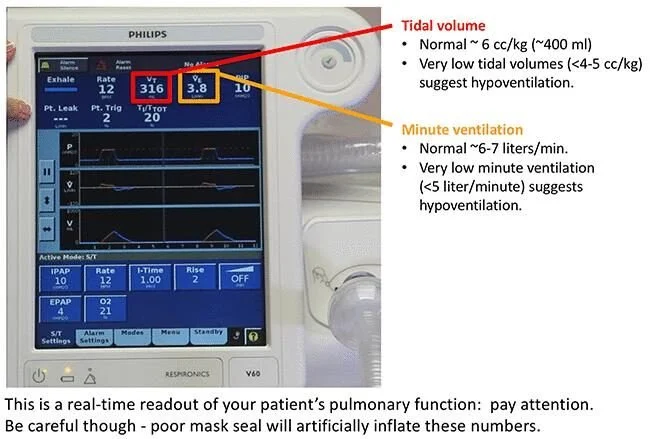
Minute ventilation: total volume moved per minute (tidal volume × respiratory rate).
How to tell whether NIPPV is working
1. Oxygenation: a pulse oximeter with a good waveform is a simple way to confirm adequate oxygenation.
2. Work of breathing: reassess respiratory rate continuously. Warning signs of impending intubation include retractions, persistent tripoding, diaphoresis, abdominal breathing, and shallow breathing. Treat the patient, not the VBG/ABG. Clinical assessment should tell you if CO₂ is rising.
3. Mentation: a patient who is mentating appropriately does not have life-threatening CO₂ narcosis.
4. The BiPAP monitor: check tidal volume and minute ventilation repeatedly. Adequate values suggest a good response. Poor tidal volumes mean the patient is hypoventilating and may need intubation.
Clinical pearls
Match the setting to the problem: CO₂ → IPAP; oxygen → EPAP; work of breathing → pressure support.
Watch the numbers on the screen. Tidal volume and minute ventilation are your early warning system.
In obstructive disease, give the patient time to exhale (shorter I-time, I:E of at least 1:2).
