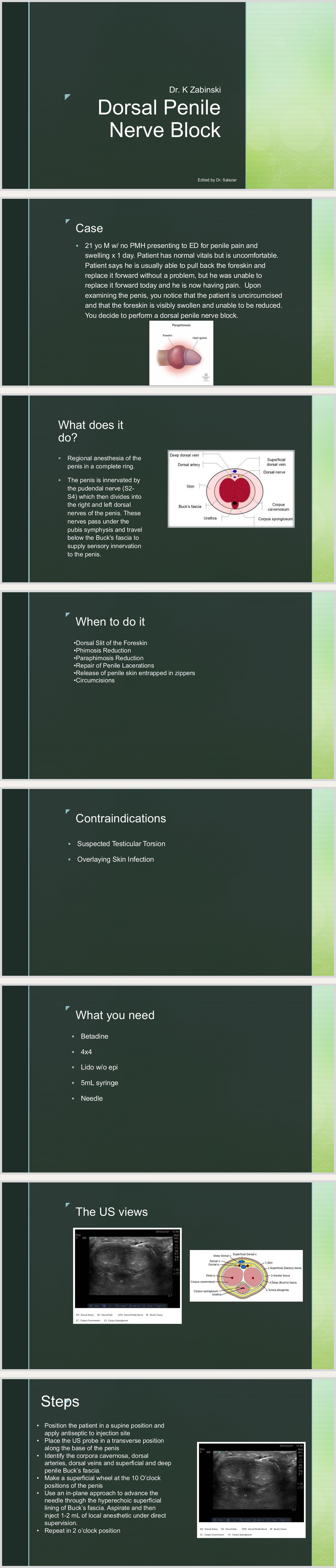

Case
A 21-year-old man with no past medical history presents to the ED with penile pain and swelling for 1 day. His vital signs are normal, but he is uncomfortable. He says he is usually able to pull back the foreskin and replace it without a problem, but today he was unable to replace it and is now having pain. On exam, he is uncircumcised and the foreskin is visibly swollen and cannot be reduced (paraphimosis). You decide to perform a dorsal penile nerve block.
What does it do?
Regional anesthesia of the penis in a complete ring.
The penis is innervated by the pudendal nerve (S2–S4), which divides into the right and left dorsal nerves of the penis. These nerves pass under the pubic symphysis and travel below Buck's fascia to supply sensory innervation to the penis.
When to do it
Dorsal slit of the foreskin
Phimosis reduction
Paraphimosis reduction
Repair of penile lacerations
Release of penile skin entrapped in zippers
Circumcisions
Contraindications
Suspected testicular torsion
Overlying skin infection
What you need
Betadine
4×4 gauze
Lidocaine without epinephrine
5 mL syringe
Needle
Steps
Position the patient supine and apply antiseptic to the injection site.
Place the ultrasound probe in a transverse position along the base of the penis.
Identify the corpora cavernosa, dorsal arteries, dorsal veins, and the superficial and deep penile (Buck's) fascia.
Make a superficial wheal at the 10 o'clock position of the penis.
Using an in-plane approach, advance the needle through the hyperechoic superficial lining of Buck's fascia. Aspirate, then inject 1–2 mL of local anesthetic under direct visualization.
Repeat at the 2 o'clock position.
The original slides, including the ultrasound views and cross-sectional anatomy, are shown below.