

Life after death: care of the post-arrest patient
ROSC is just the beginning. What happens next has a major effect on survival and neurologic outcome.
Why it matters
More than 600,000 people have a cardiac arrest each year in the United States.
Overall survival to hospital discharge in adults is about 9% after out-of-hospital arrest and 23% after in-hospital arrest.
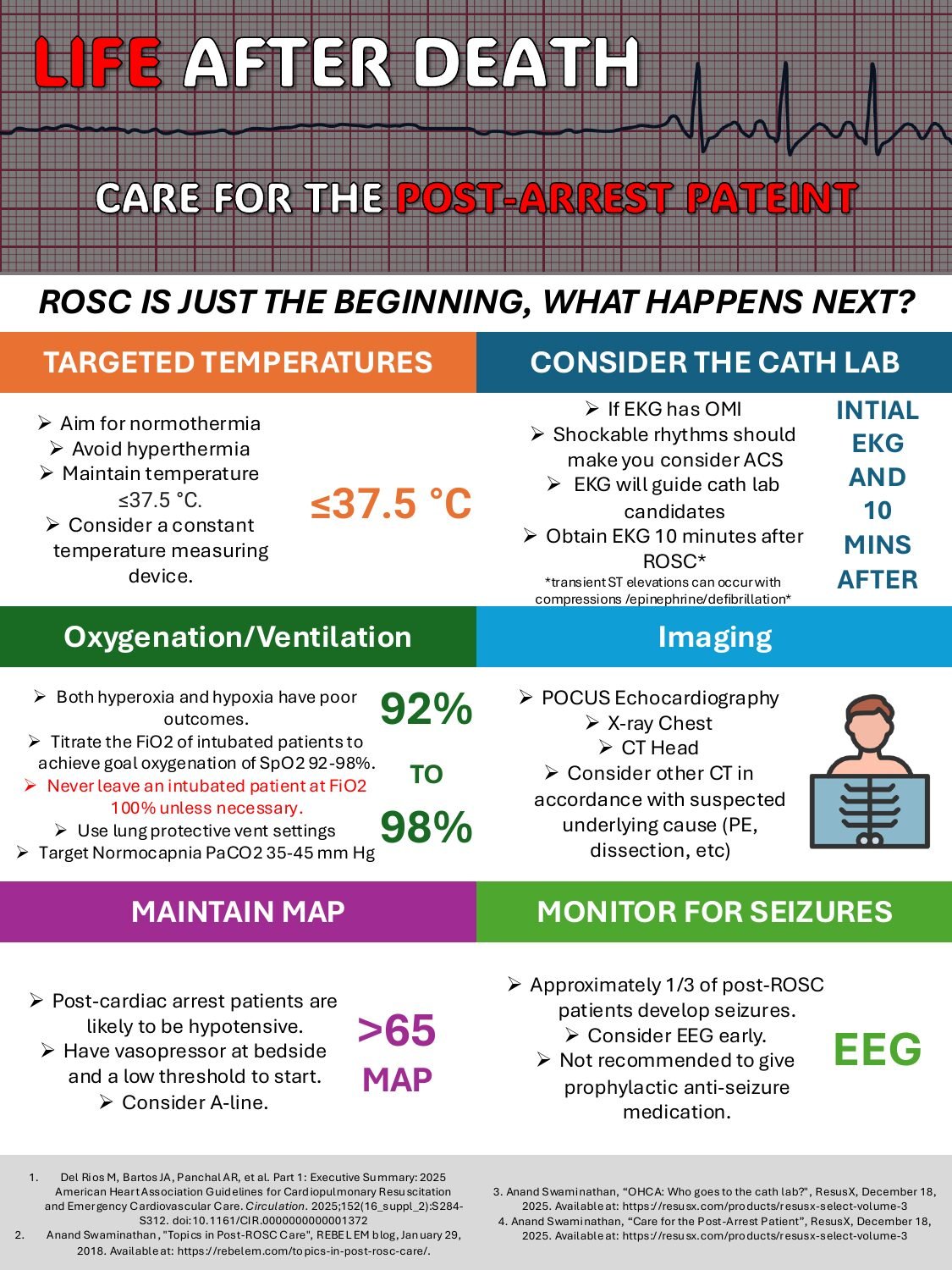
Post-arrest care has many parts: oxygenation and ventilation, hemodynamics, temperature control, seizure monitoring, coronary angiography decisions, and imaging.
Post-ROSC priorities
Oxygenation and ventilation
Both hyperoxia and hypoxia are associated with poor outcomes.
In intubated patients, titrate FiO₂ to SpO₂ 92–98%. Do not leave an intubated patient on FiO₂ 100% unless necessary.
Use lung-protective ventilator settings.
Target normocapnia: PaCO₂ 35–45 mmHg.
Maintain MAP
Post-arrest patients are likely to become hypotensive.
Target MAP > 65 mmHg.
Keep a vasopressor at the bedside and have a low threshold to start it.
Consider an arterial line.
Temperature
Aim for normothermia and actively avoid hyperthermia. Keep temperature ≤ 37.5 °C.
Consider a device that measures temperature continuously.
Consider the cath lab
Obtain an ECG on arrival and repeat it about 10 minutes after ROSC. Transient ST elevations can follow compressions, epinephrine, and defibrillation.
The ECG guides selection of cath lab candidates. Activate for an occlusion MI (OMI).
A shockable initial rhythm should make you consider acute coronary syndrome.
Imaging
POCUS echocardiography
Chest X-ray
CT head
Other CT based on the suspected cause (for example, pulmonary embolism or aortic dissection)
Monitor for seizures
About one-third of post-ROSC patients develop seizures.
Consider EEG early.
Prophylactic anti-seizure medication is not recommended.
Quick reference
| Domain | Target or action |
|---|---|
| Oxygenation | SpO₂ 92–98%; avoid FiO₂ 100% when unnecessary |
| Ventilation | PaCO₂ 35–45 mmHg; lung-protective settings |
| Blood pressure | MAP > 65 mmHg; early vasopressor; consider arterial line |
| Temperature | ≤ 37.5 °C; avoid hyperthermia |
| ECG | On arrival and ~10 min after ROSC; OMI → cath lab |
| Neuro | Consider early EEG; no seizure prophylaxis |
References
Del Rios M, Bartos JA, Panchal AR, et al. Part 1: Executive summary: 2025 American Heart Association Guidelines for Cardiopulmonary Resuscitation and Emergency Cardiovascular Care. Circulation. 2025;152(16 suppl 2):S284–S312. doi:10.1161/CIR.0000000000001372
Swaminathan A. Topics in post-ROSC care. REBEL EM. January 29, 2018.
Swaminathan A. OHCA: Who goes to the cath lab? ResusX Select, Volume 3. December 18, 2025.
Swaminathan A. Care for the post-arrest patient. ResusX Select, Volume 3. December 18, 2025.
